

Volume 34, Issue 4 (12-2025)
JGUMS 2025, 34(4): 396-409 |
Back to browse issues page



Research code: IR.MUI.NUREMA.REC.1400.145
Ethics code: IR.MUI.NUREMA.REC.1400.145


Download citation:
BibTeX | RIS | EndNote | Medlars | ProCite | Reference Manager | RefWorks
Send citation to:


BibTeX | RIS | EndNote | Medlars | ProCite | Reference Manager | RefWorks
Send citation to:
Khoshkchali A, Torkian S, Majidnia M, Torkian S. The attitude of healthcare workers at Isfahan University of Medical Sciences towards childbearing after covid-19 pandemic in 2022. JGUMS 2025; 34 (4) :396-409
URL: http://journal.gums.ac.ir/article-1-2732-en.html
URL: http://journal.gums.ac.ir/article-1-2732-en.html


1- Student Research Committee, School of Public Health, Isfahan University of Medical Sciences, Isfahan, Iran.
2- Department of Health Education and Promotion, Nutrition and Food Security Research Center, School of Health, Isfahan University of Medical Sciences, Isfahan, Iran.
3- Department of Epidemiology and Biostatistics, School of Medicine, Kurdistan University of Medical Sciences, Kurdistan, Iran.
4- Department of Epidemiology, School of Health, Iran University of Medical Sciences, Tehran, Iran.
2- Department of Health Education and Promotion, Nutrition and Food Security Research Center, School of Health, Isfahan University of Medical Sciences, Isfahan, Iran.
3- Department of Epidemiology and Biostatistics, School of Medicine, Kurdistan University of Medical Sciences, Kurdistan, Iran.
4- Department of Epidemiology, School of Health, Iran University of Medical Sciences, Tehran, Iran.
Keywords: Attitude of Health Personnel, Delayed Childbearing, Attitude, Healthcare Workers, Covid-19
Full-Text [PDF 4737 kb]
(115 Downloads)
| Abstract (HTML) (967 Views)
Full-Text: (176 Views)
Introduction
A country’s population policies are determined based on its socio-economic development goals [1]. Iran, a developing country, has experienced a rapid decline in fertility rates over the past few decades. Although the conventional view of declining fertility in recent years has been related to economic pressures, with the improvement of economic conditions, families have tended to maintain their children’s quality of life rather than increase their number [2, 3].
The COVID-19 pandemic has impacted various aspects of life, including social spheres and childbearing plans. After the pandemic, unemployment, economic stagnation in society, and the level of anxiety and despair regarding individuals’ future careers have risen, which has indirectly impacted the fertility rate [4, 5]. Studies have shown that negative attitudes of healthcare workers (HCW) affect mothers’ well-being and satisfaction with the services they receive. Factors that influence the attitudes and behaviors of HCW indicate that strengthening health systems and developing the workforce, including improving communication and counseling skills, are of particular importance [6].
Given the concern about the global fertility rate reduction to 0.8 and reaching negative growth by 2025-2030 in various countries, including Iran [7], the present study was conducted to determine the attitudes of HCW at Isfahan University of Medical Sciences towards childbearing in 2022.
Methods
This descriptive-analytical study was conducted using available samples from the Isfahan Provincial Health Center and its affiliated healthcare networks. The sample size was estimated to be 2465 according to the study by Meshkati et al. [26]. Data were collected using researcher-made questionnaires containing two parts of demographic variables (age, gender, marital status, level of education, age at marriage, number of children, work experience, and duration of cohabitation) and the Attitude toward fertility and childbearing scale, which asked questions about employees’ desire to have children. Descriptive indices (frequency, percentage, Mean±SD) were used to describe the data. chi-square, independent t-test, analysis of variance (ANOVA), and linear regression analysis were used to compare scores between groups and determine the predictive role of independent variables in the study on attitude. Data were analyzed using STATA software, version 17, with a significance level of P<0.05.
Results
Of the 2830 participants in the study, 2248(79.43%) were female and 582(20.57%) were male. The Mean±SD of the participants’ age were 38.31±7.96 years, with a minimum of 18 and a maximum of 65 years. Among them, 2358 were married, with a mean age at marriage of 25.09±4.96 years, and the minimum and maximum ages at marriage were 10 and 52 years, respectively.
The mean score of the attitude domain was 55.81±7.85 with a minimum of 25 and a maximum of 91. The ANOVA results showed that the average attitude score did not differ significantly in any of the cities (F=0.97, P=0.508). Also, the attitude score based on place of employment did not reveal a significant difference between the two groups: Headquarters (56.01±8.06) and health centers (55.73±7.71) (F=0.856, P=0.392).
The relationship between the level of education and marital status of individuals, with the attitude score displayed that individuals with a doctoral degree and singles had higher attitude scores than those with other educational levels. The duration of cohabitation showed a significant correlation with the attitude score, and as cohabitation increased the attitude score towards childbearing also improved (P<0.005).
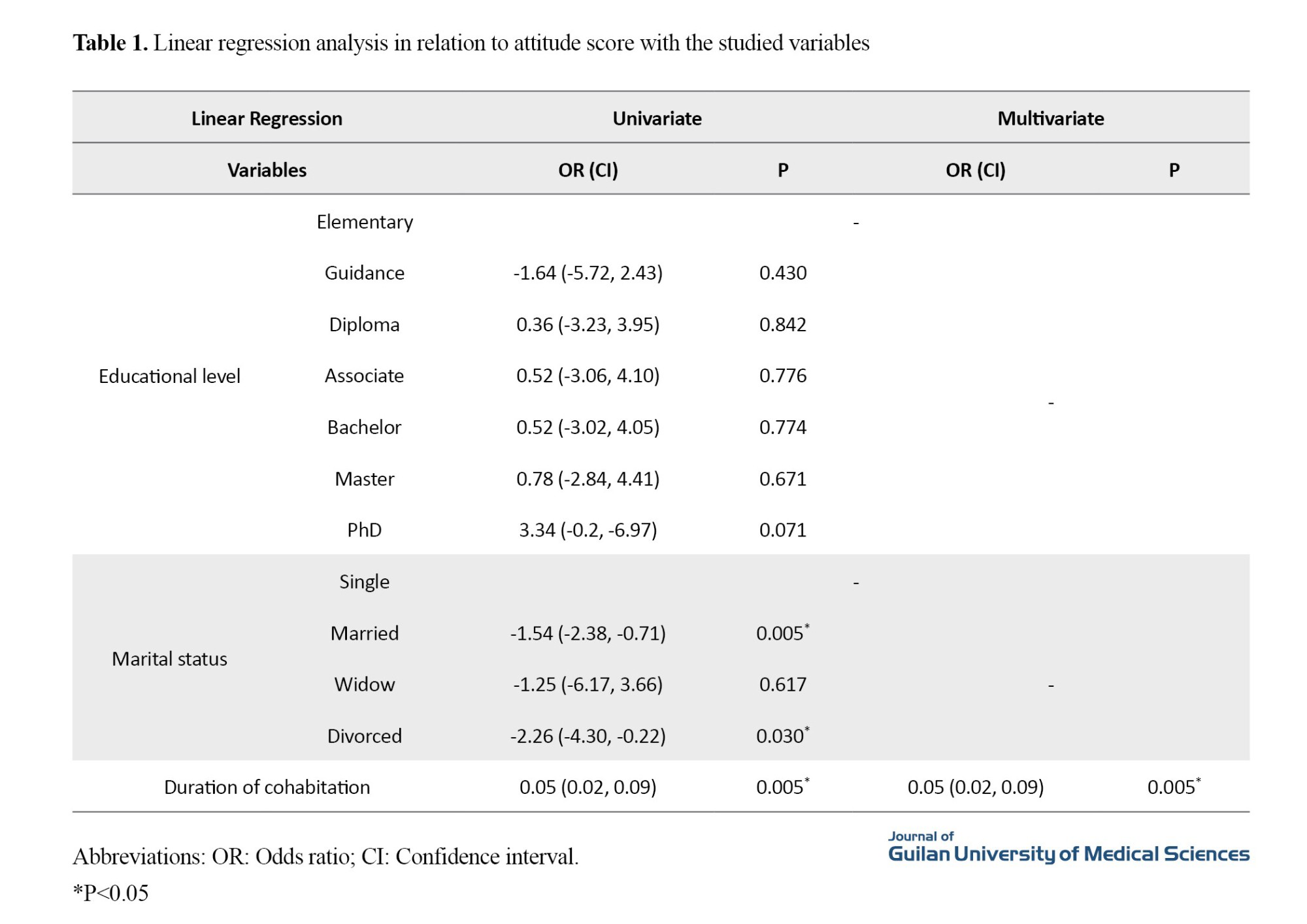
Based on univariate linear regression analysis, no significant relationship was observed between any of the educational levels and the attitude score (P>0.005). However, a significant relationship was observed between marital status and the duration of cohabitation, as well as the attitude score. In multivariate analysis, a significant relationship was observed only between duration of cohabitation and attitude score, meaning that a one-year increase in duration of cohabitation was associated with a decrease in the attitude score towards childbearing of 0.95 (P<0.005) (Table 1).
Conclusion
The results of the present study showed that the attitude score was significantly related to the occupational status and marital status of the participants, with individuals in a dentist’s job and those were single reporting a higher score. Also, in the linear regression analysis, the attitude score demonstrated a significant relationship with marital status and duration of cohabitation, which means that with an increase of one year in the duration of cohabitation, the childbearing score decreased by 0.95.
In a cross-sectional study by Dundar et al. [32]. examining the effect of the COVID-19 pandemic on the attitudes of 20–30-year-old Turkish women towards childbearing, the desire to have children decreased, and the attitude of individuals towards this issue was reported to be negative. Although the Turkish study included women who had not yet become mothers, its results were consistent with ours. In the present study, the attitude towards childbearing also decreased with an increase in the duration of cohabitation. Due to the COVID-19 pandemic and fear of the disease, economic and career problems have been proposed as reasons for this issue. Due to the COVID-19 pandemic, the fear of the disease has led to a decline in people’s desire to have children, which may persist in some regions after the pandemic [9].
In this study, people had a positive attitude towards having children. The attitude score was higher in women than in men, and the attitude score increased with higher levels of education. Contrary to the present study, Chen et al. reported that the effects of the COVID-19 pandemic on fertility intentions in women of reproductive age were negative. The emergence of COVID-19 has led to an increase in mortality and a reduction in birth rates. This global crisis has had negative impacts on the society’s economy and a decrease in motivation to have children [10]. In this study, the attitude score showed a significant relationship with occupation, with dentists exhibiting a higher attitude level. These results contradicted the study by Enayat et al. [45]. They reported that the occupation of the people did not affect their attitude towards having children, which could be related to the time of the study and the sample size of the two studies [11]. The present study reported a significant relationship due to the larger sample size.
In general, the global fertility rate has decreased over the past 50 years, and the maternal age at first pregnancy has increased [12]. Therefore, to establish a suitable population structure for the future and increase the attitudes of couples, especially health professionals, during cohabitation and in critical situations, it is necessary to implement educational and support programs as well as more effective interventions.
Ethical Considerations
Compliance with ethical guidelines
This study was approved by the Ethics Committee of Isfahan University of Medical Sciences, Isfahan, Iran (Code: IR.MUI.NUREMA.REC.1400.145).
Funding
This study was financially supported by the Deputy of Research and Technology of Isfahan University of Medical Sciences, Isfahan, Iran .
Authors contributions
Conceptualization, study design, critical revision of the manuscript and funding: Sahebjan Torkian; Data collection, data analysis and Statistical analysis: Mostafa Majidnia and Samaneh Torkian; Drafting of the manuscript: Atefeh Khoshkchali and Sahebjan Torkian; Administrative, technical support: Sahebjan Torkian, Atefeh Khoshkchali; Study supervision: All authors.
Conflicts of interest
The authors declared no conflicts of interest.
Acknowledgements
The authors express their gratitude to the Deputy of Research and Technology at Isfahan University of Medical Sciences and the Deputy of Health, and the HCW who participated in our study.
A country’s population policies are determined based on its socio-economic development goals [1]. Iran, a developing country, has experienced a rapid decline in fertility rates over the past few decades. Although the conventional view of declining fertility in recent years has been related to economic pressures, with the improvement of economic conditions, families have tended to maintain their children’s quality of life rather than increase their number [2, 3].
The COVID-19 pandemic has impacted various aspects of life, including social spheres and childbearing plans. After the pandemic, unemployment, economic stagnation in society, and the level of anxiety and despair regarding individuals’ future careers have risen, which has indirectly impacted the fertility rate [4, 5]. Studies have shown that negative attitudes of healthcare workers (HCW) affect mothers’ well-being and satisfaction with the services they receive. Factors that influence the attitudes and behaviors of HCW indicate that strengthening health systems and developing the workforce, including improving communication and counseling skills, are of particular importance [6].
Given the concern about the global fertility rate reduction to 0.8 and reaching negative growth by 2025-2030 in various countries, including Iran [7], the present study was conducted to determine the attitudes of HCW at Isfahan University of Medical Sciences towards childbearing in 2022.
Methods
This descriptive-analytical study was conducted using available samples from the Isfahan Provincial Health Center and its affiliated healthcare networks. The sample size was estimated to be 2465 according to the study by Meshkati et al. [26]. Data were collected using researcher-made questionnaires containing two parts of demographic variables (age, gender, marital status, level of education, age at marriage, number of children, work experience, and duration of cohabitation) and the Attitude toward fertility and childbearing scale, which asked questions about employees’ desire to have children. Descriptive indices (frequency, percentage, Mean±SD) were used to describe the data. chi-square, independent t-test, analysis of variance (ANOVA), and linear regression analysis were used to compare scores between groups and determine the predictive role of independent variables in the study on attitude. Data were analyzed using STATA software, version 17, with a significance level of P<0.05.
Results
Of the 2830 participants in the study, 2248(79.43%) were female and 582(20.57%) were male. The Mean±SD of the participants’ age were 38.31±7.96 years, with a minimum of 18 and a maximum of 65 years. Among them, 2358 were married, with a mean age at marriage of 25.09±4.96 years, and the minimum and maximum ages at marriage were 10 and 52 years, respectively.
The mean score of the attitude domain was 55.81±7.85 with a minimum of 25 and a maximum of 91. The ANOVA results showed that the average attitude score did not differ significantly in any of the cities (F=0.97, P=0.508). Also, the attitude score based on place of employment did not reveal a significant difference between the two groups: Headquarters (56.01±8.06) and health centers (55.73±7.71) (F=0.856, P=0.392).
The relationship between the level of education and marital status of individuals, with the attitude score displayed that individuals with a doctoral degree and singles had higher attitude scores than those with other educational levels. The duration of cohabitation showed a significant correlation with the attitude score, and as cohabitation increased the attitude score towards childbearing also improved (P<0.005).
Based on univariate linear regression analysis, no significant relationship was observed between any of the educational levels and the attitude score (P>0.005). However, a significant relationship was observed between marital status and the duration of cohabitation, as well as the attitude score. In multivariate analysis, a significant relationship was observed only between duration of cohabitation and attitude score, meaning that a one-year increase in duration of cohabitation was associated with a decrease in the attitude score towards childbearing of 0.95 (P<0.005) (Table 1).
Conclusion
The results of the present study showed that the attitude score was significantly related to the occupational status and marital status of the participants, with individuals in a dentist’s job and those were single reporting a higher score. Also, in the linear regression analysis, the attitude score demonstrated a significant relationship with marital status and duration of cohabitation, which means that with an increase of one year in the duration of cohabitation, the childbearing score decreased by 0.95.
In a cross-sectional study by Dundar et al. [32]. examining the effect of the COVID-19 pandemic on the attitudes of 20–30-year-old Turkish women towards childbearing, the desire to have children decreased, and the attitude of individuals towards this issue was reported to be negative. Although the Turkish study included women who had not yet become mothers, its results were consistent with ours. In the present study, the attitude towards childbearing also decreased with an increase in the duration of cohabitation. Due to the COVID-19 pandemic and fear of the disease, economic and career problems have been proposed as reasons for this issue. Due to the COVID-19 pandemic, the fear of the disease has led to a decline in people’s desire to have children, which may persist in some regions after the pandemic [9].
In this study, people had a positive attitude towards having children. The attitude score was higher in women than in men, and the attitude score increased with higher levels of education. Contrary to the present study, Chen et al. reported that the effects of the COVID-19 pandemic on fertility intentions in women of reproductive age were negative. The emergence of COVID-19 has led to an increase in mortality and a reduction in birth rates. This global crisis has had negative impacts on the society’s economy and a decrease in motivation to have children [10]. In this study, the attitude score showed a significant relationship with occupation, with dentists exhibiting a higher attitude level. These results contradicted the study by Enayat et al. [45]. They reported that the occupation of the people did not affect their attitude towards having children, which could be related to the time of the study and the sample size of the two studies [11]. The present study reported a significant relationship due to the larger sample size.
In general, the global fertility rate has decreased over the past 50 years, and the maternal age at first pregnancy has increased [12]. Therefore, to establish a suitable population structure for the future and increase the attitudes of couples, especially health professionals, during cohabitation and in critical situations, it is necessary to implement educational and support programs as well as more effective interventions.
Ethical Considerations
Compliance with ethical guidelines
This study was approved by the Ethics Committee of Isfahan University of Medical Sciences, Isfahan, Iran (Code: IR.MUI.NUREMA.REC.1400.145).
Funding
This study was financially supported by the Deputy of Research and Technology of Isfahan University of Medical Sciences, Isfahan, Iran .
Authors contributions
Conceptualization, study design, critical revision of the manuscript and funding: Sahebjan Torkian; Data collection, data analysis and Statistical analysis: Mostafa Majidnia and Samaneh Torkian; Drafting of the manuscript: Atefeh Khoshkchali and Sahebjan Torkian; Administrative, technical support: Sahebjan Torkian, Atefeh Khoshkchali; Study supervision: All authors.
Conflicts of interest
The authors declared no conflicts of interest.
Acknowledgements
The authors express their gratitude to the Deputy of Research and Technology at Isfahan University of Medical Sciences and the Deputy of Health, and the HCW who participated in our study.
References
- Sabermahani A, Goudarzi R, Nasiri S. Factors affecting fertility rate in iran (panel data 1966-2013): A survey study. Journal of Family & Reproductive Health. 2017; 11(3):138-45. [PMID]
- Jafari H, Jaafaripooyan E, Vedadhir AA, Foroushani AR, Ahadinejad B, Pourreza A. Socio-economic factors influencing on total fertility rate in Iran: A panel data analysis for the period of 2002-2012. Electronic Physician. 2016; 8(6):2551-6. [DOI:10.19082/2551] [PMID]
- Torkian Valashani S, Zamani Alavijeh F, Heidari Z, Shoushtari Moghadam E. [Fertility desire: Facilitators and inhibitors (Persian)]. Payesh. 2019; 18(3):241-9. [Link]
- Co-operation OfE, Development. Babies and bosses-reconciling work and family life (volume 1): Australia, Denmark and the Netherlands. Paris: OECD Publishing; 2002. [Link]
- United Nations. World population prospects. Volume III: Analytical report. New York: United Nations; 2004. [Link]
- Khadivzadeh T, Arghavani E, Shakeri MT. [Relationship between fertility motivations and preferences in couples (Persian)]. The Iranian Journal of Obstetrics, Gynecology and Infertility. 2014; 17(114):8-18. [DOI:10.22038/ijogi.2014.3414]
- Statistical Centre of Iran. [Indicators of the population in Iran (Persian)]. Tehran: Statistical Centre of Iran; 2020. [Link]
- World Health Organization. Aging [Internet]. 2023 [Updated 2025 October 14]. Available from: [Link]
- Erfani A. [Fertility in Tehran city and Iran: Rates, trends and differentials (Persian)]. Population Studies. 2013; 1(1):87-107. [Link]
- Ryazantsev S, Rostovskaya T, Zolotareva O. [Characteristics of the reproductive behaviour of the population in iran and russia during the pandemic period covid-19 (Russian)]. Gigiena i Sanitariya. 2021; 10:1163-70. [DOI:10.47470/0016-9900-2021-100-10-1163-1170]
- Rezaei F, Amiri-Farahani L, Haghani S, Pezaro S, Behmanesh F. Comparing reproductive intentions before and during the COVID-19 pandemic: A cross-sectional study. BMC Health Services Research. 2023; 23(1):545. [DOI:10.1186/s12913-023-09551-z] [PMID]
- Fostik A. COVID-19 and Fertility in Canada: A Commentary. Canadian Studies in Population. 2021; 48(2-3):217-24. [DOI:10.1007/s42650-021-00054-y] [PMID]
- Banaei M, Nia HS, Mokhtarian-Gilani T, Kariman N. The role of the COVID-19 pandemic on childbearing intentions in iranian women: A path analysis. Research Square. 2021; 1-19 [Unpublished]. [DOI:10.21203/rs.3.rs-368798/v1]
- Karavadra B, Stockl A, Prosser-Snelling E, Simpson P, Morris E. Women's perceptions of COVID-19 and their healthcare experiences: A qualitative thematic analysis of a national survey of pregnant women in the United Kingdom. BMC Pregnancy and Childbirth. 2020; 20(1):600. [DOI:10.1186/s12884-020-03283-2] [PMID]
- Hantoushzadeh S, Bagheri M, Amjadi MA, Farahani MF, Haghollahi F. Experiences of health care providers on pregnancy and childbirth care during the COVID-19 pandemic in Iran: A phenomenological study. BMC Pregnancy Childbirth. 2021; 21(1):670. [DOI:10.1186/s12884-021-04148-y] [PMID]
- Buttiëns H, Marchal B, De Brouwere V. Skilled attendance at childbirth: let us go beyond the rhetorics. Tropical Medicine & International Health. 2004; 9(6):653-4. [DOI:10.1111/j.1365-3156.2004.01256.x] [PMID]
- World Health Organization. The world health report 2005: make every mother and child count. Geneva: World Health Organization; 2005. [Link]
- Mannava P, Durrant K, Fisher J, Chersich M, Luchters S. Attitudes and behaviours of maternal health care providers in interactions with clients: A systematic review. Globalization and Health. 2015; 11(1):36. [DOI:10.1186/s12992-015-0117-9] [PMID]
- Jafari H, Pourreza A, Kabiri N, Khodyari-Zarnaq R. Main actors in the new population policy with a growing trend in Iran: A stakeholder analysis. Journal of Health, Population and Nutrition. 2022; 41(1):57. [DOI:10.1186/s41043-022-00338-2] [PMID]
- Aloosh M, Saghai Y. Birth control policies in Iran: A public health and ethics perspective. Journal of Epidemiology and Community Health. 2016; 70(6):529-33. [PMID]
- Roudsari RL, Khadivzadeh T, Bahrami M. A grounded theory approach to understand the process of decision making on fertility control methods in urban society of Mashhad, Iran. Iranian Journal of Nursing and Midwifery Research. 2013; 18(5):408-15. [PMID]
- Rahmati R, Khadivzadeh T, Esmaily H, Bahrami HR. Knowledge and attitude of staff working in healthcare centers regarding childbearing. Journal of Midwifery & Reproductive Health. 2019; 7(1):1576-83. [Link]
- Khadivzade T, Arghavani E, Shokrollahi P, Ghazanfarpour M, Kareshki H. Factorial structure of the Persian version of Childbearing Questionnaire in first time engaged couples in Iran. Journal of Obstetrics and Gynaecology. 2018; 38(4):470-5. [DOI:10.1080/01443615.2017.1379967] [PMID]
- Naderipour F, Abolghasemi J, Dehdari T, Nouri R. [Attitude of childless married women towards childbearing in Zanjan, Iran (Persian)]. Payesh. 2023; 22(3):335-43. [DOI:10.61186/payesh.22.3.335]
- Hewawasam E, Davies CE, Gulyani A, Li Z, Clayton PA, Sullivan E, et al. Factors influencing fertility rates in Australian women receiving kidney replacement therapy: Analysis of linked Australia and New Zealand Dialysis and transplant registry and perinatal data over 22 years. Nephrology, Dialysis, Transplantation. 2022; 37(6):1152-61. [DOI:10.1093/ndt/gfab157] [PMID]
- Meshkati M, Hajari A, Mostajeran M, Nematolahi S, Mohammadian-Hafshejani-Hafshejani A, Hosseiny L. [Knowledge and attitudes of married women referred to health centers affiliated to Isfahan University of Medical Sciences, Iran, about AIDS and related factors (Persian)]. Journal of Mazandaran University of Medical Sciences. 2013; 23(108):100-7. [Link]
- Pizzirusso M, Carrion-Park C, Clark US, Gonzalez J, Byrd D, Morgello S. Physical and mental health screening in a new york city hiv cohort during the COVID-19 pandemic: A preliminary report. Journal of Acquired Immune Deficiency Syndromes. 2021; 86(3):e54-60. [DOI:10.1097/QAI.0000000000002564] [PMID]
- Söderberg M, Lundgren I, Christensson K, Hildingsson I. Attitudes toward fertility and childbearing scale: An assessment of a new instrument for women who are not yet mothers in Sweden. BMC Pregnancy and Childbirth. 2013; 13:197. [DOI:10.1186/1471-2393-13-197] [PMID]
- Baezzat F, Ahmadi Ghozlojeh A, Marzbani Y, Karimi A, Azarnioshan B. [A study of psychometric properties of Persian Version Of Attitudes Toward Fertility And Childbearing Scale (Persian)]. Nursing and Midwifery Journal. 2017; 15(1):37-47. [Link]
- Kordzanganeh J, Mohamadian H. [Psychometric assessment of the validity of the Iranian version of attitude toward fertility and childbearing inventory in women without a history of pregnancy in the South of Iran (Persian)]. Journal of School of Public Health & Institute of Public Health Research. 2019; 17(1):83-93. [Link]
- Rakotosamimanana S, Mangahasimbola RT, Ratovoson R, Randremanana RV. Determinants of COVID-19-related knowledge and disrupted habits during epidemic waves among women of childbearing age in urban and rural areas of the Malagasy Middle East. BMC Public Health. 2023; 23(1):1990. [DOI:10.1186/s12889-023-16931-x] [PMID]
- Dundar C, Elverdi TK. The impact of the COVID-19 pandemic on the attitude towards childbearing of married aged 20-30 Turkish women who are not yet mothers: A cross-sectional study. BMC Public Health. 2023; 23(1):1050. [DOI:10.1186/s12889-023-15976-2] [PMID]
- Afshari P, Abedi P, Beheshtinasab M. Fertility decision of Iranian women during the COVID-19 pandemic and home quarantine: A cross-sectional study in Iran. Frontiers in Psychology. 2022; 13:993122. [DOI:10.3389/fpsyg.2022.993122] [PMID]
- Mizrak Sahin B, Kabakci EN. The experiences of pregnant women during the COVID-19 pandemic in Turkey: A qualitative study. Women and Birth. 2021; 34(2):162-9. [DOI:10.1016/j.wombi.2020.09.022] [PMID]
- Chen T, Hou P, Wu T, Yang J. The impacts of the COVID-19 pandemic on fertility intentions of women with childbearing age in China. Behavioral Sciences. 2022; 12(9):335. [DOI:10.3390/bs12090335] [PMID]
- Fakehi M, Hashemnejad MM, Ghanbari S, Hashemi N, Saadati Shamir R, Heidary Z. Nulliparous women’s attitudes toward fertility and childbearing in COVID-19 pandemic. Fertility, Gynecology and Andrology. 2021; 1:e123477. [DOI:10.5812/fga.123477]
- Afrazandeh SS, Khosravi M, Bahador F, Javanmard Z, Sabahi A. Decision-making factors in the childbearing of women working at Birjand University of Medical Sciences during COVID-19 pandemic. Clinical Epidemiology and Global Health. 2024; 25:101506. [DOI:10.1016/j.cegh.2024.101506]
- Ameri F, Dastani M, Sabahi A, Hooshangi F, Rahimkarimi M, Rajabi E, et al. The role of e-health literacy in preventive behaviors for COVID-19: A systematic review. Journal of Health Literacy. 2022; 6(4):88-97. [DOI:10.22038/jhl.2021.61581.1241]
- Sun X, Shi Y, Zeng Q, Wang Y, Du W, Wei N, et al. Determinants of health literacy and health behavior regarding infectious respiratory diseases: A pathway model. BMC Public Health. 2013; 13(1):261. [DOI:10.1186/1471-2458-13-261] [PMID]
- Hushmandi K, Saghari S, Raesi R. Assessing the attitude of women towards pregnancy, childbirth, and child care during the COVID-19 pandemic (A cross-sectional study). The Open Public Health Journal. 2023; 16(1):1-7. [DOI:10.2174/18749445-v16-2305300-2023-49]
- Emery T, Koops JC. The impact of COVID-19 on fertility behaviour and intentions in a middle income country. Plos One. 2022; 17(1):e0261509. [DOI:10.1371/journal.pone.0261509] [PMID]
- Lawson AK, McQueen DB, Swanson AC, Confino R, Feinberg EC, Pavone ME. Psychological distress and postponed fertility care during the COVID-19 pandemic. Journal of Assisted Reproduction and Genetics. 2021; 38(2):333-41. [DOI:10.1007/s10815-020-02023-x] [PMID]
- Alijanzadeh M, Bahrami N, Jafari E, Noori M, Miri F, Joftyar M, et al. Iranian women's attitude toward childbearing and its' association with generalized trust, social support, marital satisfaction and governmental childbearing incentives. Heliyon. 2023; 9(5):e16162. [DOI:10.1016/j.heliyon.2023.e16162] [PMID]
- Yang H, Wang C, Poon LC. Novel coronavirus infection and pregnancy. Ultrasound in Obstetrics & Gynecology. 2020; 55(4):435-7. [DOI:10.1002/uog.22006] [PMID]
- Enayat H, Parnian L. The study of cultural globalization and tendency to fertility. Quarterly Journal of Woman and Society. 2013; 4(2):109-36. [Link]
Review Paper: Research |
Subject:
General
Received: 2024/10/6 | Accepted: 2025/04/13 | Published: 2026/01/1
Received: 2024/10/6 | Accepted: 2025/04/13 | Published: 2026/01/1
| Rights and permissions | |
 |
This work is licensed under a Creative Commons Attribution-NonCommercial 4.0 International License. |

Copyright © The Author(s);
This is an open access article distributed under the terms of the
Creative Commons Attribution License (CC-By-NC),which permits use, distribution, and reproduction in any medium,
provided the original work is properly cited and is not used forcommercial purposes.
Contact Information