

Volume 32, Issue 3 (10-2023)
JGUMS 2023, 32(3): 250-265 |
Back to browse issues page


Research code: IR.IAU.ARDABIL.REC.1400.050
Ethics code: IR.IAU.ARDABIL.REC.1400.050


Download citation:
BibTeX | RIS | EndNote | Medlars | ProCite | Reference Manager | RefWorks
Send citation to:


BibTeX | RIS | EndNote | Medlars | ProCite | Reference Manager | RefWorks
Send citation to:
Porkar A, Sattari S, Moghadamnia M T. Pathology of the Training Process for the Incident Command System Staff of Hospitals in Guilan Province, Iran, Based on the Three-pronged Approach. JGUMS 2023; 32 (3) :250-265
URL: http://journal.gums.ac.ir/article-1-2538-en.html
URL: http://journal.gums.ac.ir/article-1-2538-en.html


1- Department of Educational Sciences, Faculty of Humanities, Ardabil Branch, Islamic Azad University, Ardabil, Iran., Ardabil
2- Department of Educational Sciences, Faculty of Humanities, Ardabil Branch, Islamic Azad University, Ardabil, Iran.
3- Department of Prehospital Emergencies Medicine, School of Nursing and Midwifery, Guilan University of Medical Sciences, Rasht, Iran., Guilan
2- Department of Educational Sciences, Faculty of Humanities, Ardabil Branch, Islamic Azad University, Ardabil, Iran.
3- Department of Prehospital Emergencies Medicine, School of Nursing and Midwifery, Guilan University of Medical Sciences, Rasht, Iran., Guilan
Full-Text [PDF 6783 kb]
(777 Downloads)
| Abstract (HTML) (1949 Views)
Conclusion
Based on the findings, physical-infrastructure, strategic (organizational structure), policy-making and executive, organizational and educational, managerial and support, and organizational goals and specialized measures were the factors that negatively affected the process of training for the HICS staff of hospitals in Guilan Province and led to the inappropriate use of staff against accidents and crisis. The most important areas of failure in proper training of the HICS staff of hospitals in Guilan Province were related to the processes and structure.
Ethical Considerations
Compliance with ethical guidelines
This study was approved by the Research Ethics Committee of Islamic Azad University, Ardabil Branch (Code: IR.IAU.ARDABIL.REC.1400.050). Obtaining informed consent from the participants and ensuring the confidentiality of their information were considered in this study.
Funding
This article was extracted from PhD thesis of Arezou Porkar, Department of Educational Sciences, Faculty of Humanities, Ardabil Branch, Islamic Azad University, Ardabil, Iran.
Authors' contributions
Conceptualization and study design and critical revision of the manuscript for important intellectual content: All authors; Data acquisition, data analysis and drafting of the manuscript: Arezou Porkar and Sadraddin Sattari; Statistical analysis, administrative, technical, or material support: Arezou Porkar and Mohammad Taghi Moghadamnia; Supervision: Sadraddin Sattari and Mohammad Taghi Moghadamnia.
Conflicts of interest
The authors declared no conflict of interest.
Acknowledgments
The authors would like to thank the experts for their guidance and assistance in this research.
References
Full-Text: (1481 Views)
Introduction
The most important factor of productivity and growth in organizations and society is human resource [1], which is more evident in organizations such as hospitals that depend on their staff for providing services [2]. One of the serious weaknesses in hospitals is the lack of attention to or neglect of using a correct model in the subject for teaching the Hopstal incident command system (HICS) staff [3]. The HICS is a system for managing emergency events or crisis in hospitals [4]. For teaching the HICS staff, professional educational programs should be held in different formats on how to deal with possible incidents, but a study showed that the training courses of hospitals do not have the necessary effectiveness in many staff [5] and there is a need for a systematic revision of the entire training process [6] and assessing the pathology of this process for planning to ensure the quality and effectiveness of training [7]. Various models have been presented for the this purpose. The most suitable method is the three-pronged approach [8].
Methods
This is a qualitative-quantitative study (a mixed method). The study population in the qualitative phase included expert in planning, development, and training of the HICS staff. In the quantitative phase, the study population included all managers and staff of the HICS in the hospitals of Guilan Province (n=548). The sampling method in the qualitative phase was the purposive method, while the cluster random method was used in the quantitative phase. According to the principle of data saturation, the sample size in the qualitative phase was 15. In the quantitative phase, sample size was determined 226 based on Cochran’s formula. The data collection tool was a semi-structured interview in the qualitative phase and a researcher-made questionnaire based on a five-point Likert scale in the quantitative phase. The face validity of the questionnaire was confirmed in a pilot study and the content validity was confirmed based on the opinions of experts. The reliability of the questionnaire using Cronbach’s α coefficient was 0.84. For data analysis, MAXQDA software, version 2020 was used in the qualitative phase and SPSS software, version 26 was used in the quantitative phase.
Results
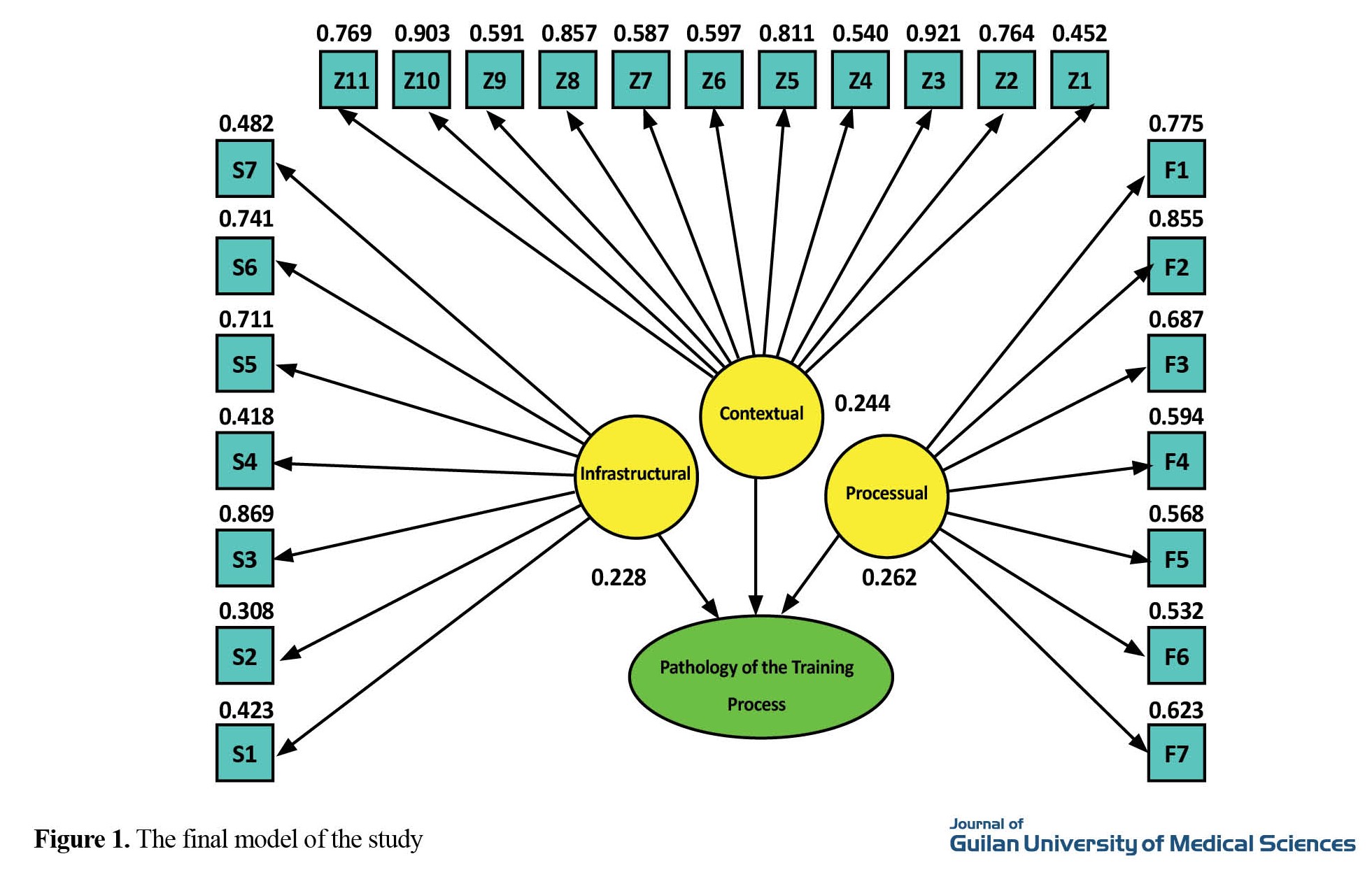
In the qualitative phase, after analyzing the codes extracted from the interviews with experts (55 open codes, 25 axial codes, and 6 selective codes), physical-infrastructure, strategic (organizational structure), policy-making and executive, organizational and educational processes, management and support, and organizational goals and specialized measures were extracted, which were classified in three branches of the three-pronged model, i.e. structures, processes, and context. In the quantitative phase, the results showed that the mean amount of failure in the training of staff in all three domains was higher than the average. Among the domains, the percentage of variance (impact) was higher in the processes domain (0.262). The final model of the study based on the three-pronged approach is shown in Figure 1.
The most important factor of productivity and growth in organizations and society is human resource [1], which is more evident in organizations such as hospitals that depend on their staff for providing services [2]. One of the serious weaknesses in hospitals is the lack of attention to or neglect of using a correct model in the subject for teaching the Hopstal incident command system (HICS) staff [3]. The HICS is a system for managing emergency events or crisis in hospitals [4]. For teaching the HICS staff, professional educational programs should be held in different formats on how to deal with possible incidents, but a study showed that the training courses of hospitals do not have the necessary effectiveness in many staff [5] and there is a need for a systematic revision of the entire training process [6] and assessing the pathology of this process for planning to ensure the quality and effectiveness of training [7]. Various models have been presented for the this purpose. The most suitable method is the three-pronged approach [8].
Methods
This is a qualitative-quantitative study (a mixed method). The study population in the qualitative phase included expert in planning, development, and training of the HICS staff. In the quantitative phase, the study population included all managers and staff of the HICS in the hospitals of Guilan Province (n=548). The sampling method in the qualitative phase was the purposive method, while the cluster random method was used in the quantitative phase. According to the principle of data saturation, the sample size in the qualitative phase was 15. In the quantitative phase, sample size was determined 226 based on Cochran’s formula. The data collection tool was a semi-structured interview in the qualitative phase and a researcher-made questionnaire based on a five-point Likert scale in the quantitative phase. The face validity of the questionnaire was confirmed in a pilot study and the content validity was confirmed based on the opinions of experts. The reliability of the questionnaire using Cronbach’s α coefficient was 0.84. For data analysis, MAXQDA software, version 2020 was used in the qualitative phase and SPSS software, version 26 was used in the quantitative phase.
Results
In the qualitative phase, after analyzing the codes extracted from the interviews with experts (55 open codes, 25 axial codes, and 6 selective codes), physical-infrastructure, strategic (organizational structure), policy-making and executive, organizational and educational processes, management and support, and organizational goals and specialized measures were extracted, which were classified in three branches of the three-pronged model, i.e. structures, processes, and context. In the quantitative phase, the results showed that the mean amount of failure in the training of staff in all three domains was higher than the average. Among the domains, the percentage of variance (impact) was higher in the processes domain (0.262). The final model of the study based on the three-pronged approach is shown in Figure 1.
Conclusion
Based on the findings, physical-infrastructure, strategic (organizational structure), policy-making and executive, organizational and educational, managerial and support, and organizational goals and specialized measures were the factors that negatively affected the process of training for the HICS staff of hospitals in Guilan Province and led to the inappropriate use of staff against accidents and crisis. The most important areas of failure in proper training of the HICS staff of hospitals in Guilan Province were related to the processes and structure.
Ethical Considerations
Compliance with ethical guidelines
This study was approved by the Research Ethics Committee of Islamic Azad University, Ardabil Branch (Code: IR.IAU.ARDABIL.REC.1400.050). Obtaining informed consent from the participants and ensuring the confidentiality of their information were considered in this study.
Funding
This article was extracted from PhD thesis of Arezou Porkar, Department of Educational Sciences, Faculty of Humanities, Ardabil Branch, Islamic Azad University, Ardabil, Iran.
Authors' contributions
Conceptualization and study design and critical revision of the manuscript for important intellectual content: All authors; Data acquisition, data analysis and drafting of the manuscript: Arezou Porkar and Sadraddin Sattari; Statistical analysis, administrative, technical, or material support: Arezou Porkar and Mohammad Taghi Moghadamnia; Supervision: Sadraddin Sattari and Mohammad Taghi Moghadamnia.
Conflicts of interest
The authors declared no conflict of interest.
Acknowledgments
The authors would like to thank the experts for their guidance and assistance in this research.
References
- Haj Khozeymh M, Abili k, Pourkarime J. [Presenting a model for professional development departments heads in universities and institutes of higher education based on a lean approach (Persian)]. Educational Sciences. 2020; 27(1):221-40. [DOI:10.22055/edus.2020.32800.2996]
- Hosseini Shavoon A, Youzbashi A, Nasl Seraji R. Condition of knowledge management and factors affecting its establishment in Tehran University of Medical Sciences (Persian)]. Rahbordefarhang. 2015; 8(30):137-59. [Link]
- Shayani F, Mahmoudi M, Karimi A. [Identifying strategies for implementing and improving employee training using de-gamification approach (Persian)]. Human Resources Education and Development. 2020; 7(25):16-38. [Link]
- Aslani F, Tahmasbi S, Bordbar N. [Pathology of human resources in health and treatment network using the three-dimensional model (Persian)]. Journal of Health_Based Research. 2019; 5(1):45-56. [DOI:10.22034/5.1.45]
- Alvarez Dominguez A. The impact of human resource disclosure on corporate image. Journal of Human Resource Costing & Accounting. 2011; 15(4):279-98. [DOI:10.1108/14013381111197225]
- Anand S, Bärnighausen T. Health workers and vaccination coverage in developing countries: An econometric analysis. Lancet. 2007; 369(9569):1277-85. [DOI:10.1016/S0140-6736(07)60599-6] [PMID]
- Pourabbas A, Amini A, Asghari Jafarabadi M. [The status of accountable education in clinical education departments of Tabriz University of Medical Sciences (Persian)]. Research in Medical Education. 2020; 12(2):71-82. [DOI:10.29252/rme.12.2.71]
- Khan T, Mosgrove F, Wass V. Unknown unknowns: Can bringing patients' lived experience of long term conditions into curriculum design help our future doctors offer more holistic, socially accountable care? Education for Primary Care. 2021; 32(6):322-5. [DOI:10.1080/14739879.2021.1968319] [PMID]
- Movaafegh MR, Hosseini M, Ali Mohammadzadeh K. [The readiness level of the medical services centers in the establishment and implementation of green hospital standards in Rasht (Persian)]. Guilan University of Medical Sciences. 2020; 29(1):11-21. [Link]
- Rezaee M, Shamskia N. [A novel design model for sustainable development and safety management in the school incident command system (case study: Shahriar schools) (Persian)]. Emergency Management. 2021; 10(1):101-12. [Link]
- Naveh Ebrahim A, Jafarinia S, Hasanpoor A, Eydi A. [Metasynthesis the patterns of formulating training management strategies and human resources (Persian)]. Journal of Research on Management of Teaching in Marine Sciences. 2020; 6(4):1-18. [Link]
- Sazmand T, Niazazari K, Salehi M. [The Modeling the acquisition of scientific authority in medical education with responsive education approach (Persian)]. Journal of Research in Educational Science. 2021; 15(54):152-63. [Link]
- Shams Morkalani G, Safa’iMovahed S, Fatemisefat A. [Pathology of human resources training and improvement activities based on the three-pronged model (case study: Fajr Electronic Industries (Persian)]. Quartery Journal of Training & Development of Human Resources. 2015; 2(7):71-100. [Link]
- Manzini A. Organizational diagnosis: A practical approach to company problem solving and growth [A. Atafar, M. Ghobadipour, & S. Onalooee, Persian Trans]. Isfahan: Daneshpajoohan-barin; 2016. [Link]
- Pourasad M, Ahmadi K, Fatemy A. [Pathology of the staff training system in Iranian government organizatinal (Persian)]. Journal of Management in Organizations. 2021; 9(2):261-90. [Link]
- Rajaeepour S, Naderi N. [Abzarha va modelhaye asibshenasi sazmani (Persian)]. Isfahan: Kankash Publisher; 2009.
- Mirjani Aghdam A, Khorshidi A, Barzegar N, Moradi S, Ahmady S. [Accountable education pattern for rehabilitation sciences curriculum (Persian)]. Research in Medical Education. 2022; 14(1):13-23. [DOI:10.52547/rme.14.1.13]
- Armstrong M, Taylor S. Armstrong’s handbook of human resource management practice. Gosport: Ashford Color press; 2014. [Link]
- Esfandiari A, Nekoueimoghadam M, Mohammadi Z, Norouzi S, Amiresmaili MR. [Pathology of human resources by applying three dimensional model -2011(case study: Kerman University of Medical Sciences,Iran) (Persian)]. The Journal of Toloo-e-Behesht. 2012; 10(3):1-12. [Link]
- Tari H, Mokhtari Bae Kalai M, Kiakjuri D. [Decline of organizational ethics: Presenting a three-pronged model of organizational anomie (Persian)]. Ethics in Science and Technology 2022; 17:50-61. [Link]
- Rahmani H, Rajabi Vasokolaee G, Saeidpour J, Rezaei M, Niakan S, Khosravi B. [Pathology of human resources in Imam Khomeini hospital complex based on applying three-dimensional model (Persian)]. Journal of Hospital. 2018; 16(4):35-41. [Link]
- Chahrzad M, Mahmoudi AH, Fathi Vajargah K, Khorshidi A, Samimi Ardestani SM. [Pathology of universities’ preparedness process to establish educational accreditation of medical education centers (a qualitative research) (Persian)]. Iranian Journal of Medical Education. 2019; 19:305-15. [Link]
- Damari B, Heidari A. [Designing a management model for development plans in the field of health at the national, provincial and the district levels (Persian)]. Salāmat-I Ijtimāīh. 2017; 4(4):256-64. [DOI:10.22037/ch.v4i4.16180]
- Tracey WR. The human resources glossary: The complete desk reference for HR executives, managers, and practitioners. London: Lucie Press; 2016. [Link]
- Aazami S, Shamsuddin K, Akmal S, Azami G. The relationship between job satisfaction and psychological/physical health among Malaysian Working Women. The Malaysian Journal of Medical Sciences. 2015; 22(4):40-6. [PMID] [PMCID]
- Chao MC, Jou RC, Liao CC, Kuo CW. Workplace stress, job satisfaction, job performance, and turnover intention of health care workers in rural Taiwan. Asia-Pacific Journal of Public Health. 2015; 27(2):NP1827-36. [DOI:10.1177/1010539513506604] [PMID]
- Harper E, Castrucci BC, Bharthapudi K, Sellers K. Job satisfaction: A critical, understudied facet of workforce development in public health. Journal of Public Health Management and practice. 2015; 21(Suppl 6):S46-55. [DOI:10.1097/PHH.0000000000000296] [PMID] [PMCID]
Review Paper: Research |
Subject:
Special
Received: 2022/09/9 | Accepted: 2023/02/6 | Published: 2023/10/1
Received: 2022/09/9 | Accepted: 2023/02/6 | Published: 2023/10/1
| Rights and permissions | |
 |
This work is licensed under a Creative Commons Attribution-NonCommercial 4.0 International License. |

Copyright © The Author(s);
This is an open access article distributed under the terms of the
Creative Commons Attribution License (CC-By-NC),which permits use, distribution, and reproduction in any medium,
provided the original work is properly cited and is not used forcommercial purposes.
Contact Information