

Volume 34, Issue 2 (7-2025)
JGUMS 2025, 34(2): 130-141 |
Back to browse issues page


Ethics code: IR.GUMS.REC.1400.542


Download citation:
BibTeX | RIS | EndNote | Medlars | ProCite | Reference Manager | RefWorks
Send citation to:


BibTeX | RIS | EndNote | Medlars | ProCite | Reference Manager | RefWorks
Send citation to:
Abolhasanpour Chelaras M, Rahbar Taramsari M, Ghalandari M, Eslami Kenarsari H. Investigating the Relationship Between Islamic Work Ethics and Organizational Commitment and Related Factors in the Employees of Guilan University of Medical Sciences. JGUMS 2025; 34 (2) :130-141
URL: http://journal.gums.ac.ir/article-1-2676-en.html
URL: http://journal.gums.ac.ir/article-1-2676-en.html
Mitra Abolhasanpour Chelaras1 

 , Morteza Rahbar Taramsari *2 , Maryam Ghalandari3 , Habib Eslami Kenarsari4
, Morteza Rahbar Taramsari *2 , Maryam Ghalandari3 , Habib Eslami Kenarsari4
1- Determinants of Health Research Center, Guilan University of Medical Sciences, Rasht, Iran.
2- Department of Forensic Medicine, School of Medicine, Razi Hospital, Guilan University of Medical Sciences, Rasht, Iran.
3- Clinical Research Development Unit of Poursina Hospital, Guilan University of MedicalSciences, Rasht, Iran.
4- Vice-Chancellor for Research and Technology, Guilan University of Medical Sciences, Rasht, Iran.
2- Department of Forensic Medicine, School of Medicine, Razi Hospital, Guilan University of Medical Sciences, Rasht, Iran.
3- Clinical Research Development Unit of Poursina Hospital, Guilan University of MedicalSciences, Rasht, Iran.
4- Vice-Chancellor for Research and Technology, Guilan University of Medical Sciences, Rasht, Iran.
Full-Text [PDF 4342 kb]
(263 Downloads)
| Abstract (HTML) (981 Views)
Full-Text: (423 Views)
Introduction
Work ethic is one of the most critical topics in contemporary organizations, receiving particular attention from management, as it plays a pivotal role in increasing employees’ behavioral commitment in the workplace. Organizations are particularly keen on attracting individuals with proper ethical values, as the ethical framework of an organization is shaped by its employees. Islamic work ethics have a profound impact on organizational commitment, suggesting that the implementation of Islamic ethical principles can contribute significantly to fostering a high level of commitment among employees to the organization. The reason organizational commitment has drawn considerable interest from researchers is that it influences employee behavior within organizations and impacts various organizational variables, including turnover intentions, job performance, absenteeism, as well as job-related conflict and stress. It is also a determining factor in whether employees stay with or leave the organization. Many behaviors and actions of managers and employees are rooted in moral values and are directly influenced by ethics. In organizations, particularly in societies such as Iran, where there is a strong tradition of ethical values but also a significant gap from developed countries, neglecting work ethics can create serious challenges for organizations and undermine their legitimacy and effectiveness. This paper highlights the importance of studying work ethics and how to establish them in the hearts and minds of employees, as the lack of ethics in an organization leads to an inefficient and weak administrative system, unable to respond effectively to the needs of customers and stakeholders. Accordingly, this study investigates the relationship between Islamic work ethics and organizational commitment among the employees of Guilan University of Medical Sciences during the years 2011-2012.
Methods
This study was conducted as cross-sectional research over six months. A total of 353 employees from various departments of Guilan University of Medical Sciences were selected through proportional stratified sampling. The data collection tools included the Islamic work ethics questionnaire by Ali and Al-Kazemi (1988), Allen and Meyer’s organizational commitment scale, and a job satisfaction scale. The validity of the questionnaires was assessed by experts, and their reliability was evaluated based on the Cronbach α coefficient. Data analysis was conducted using independent t tests, Pearson correlation analysis, and univariate and multivariate linear regression.
Results
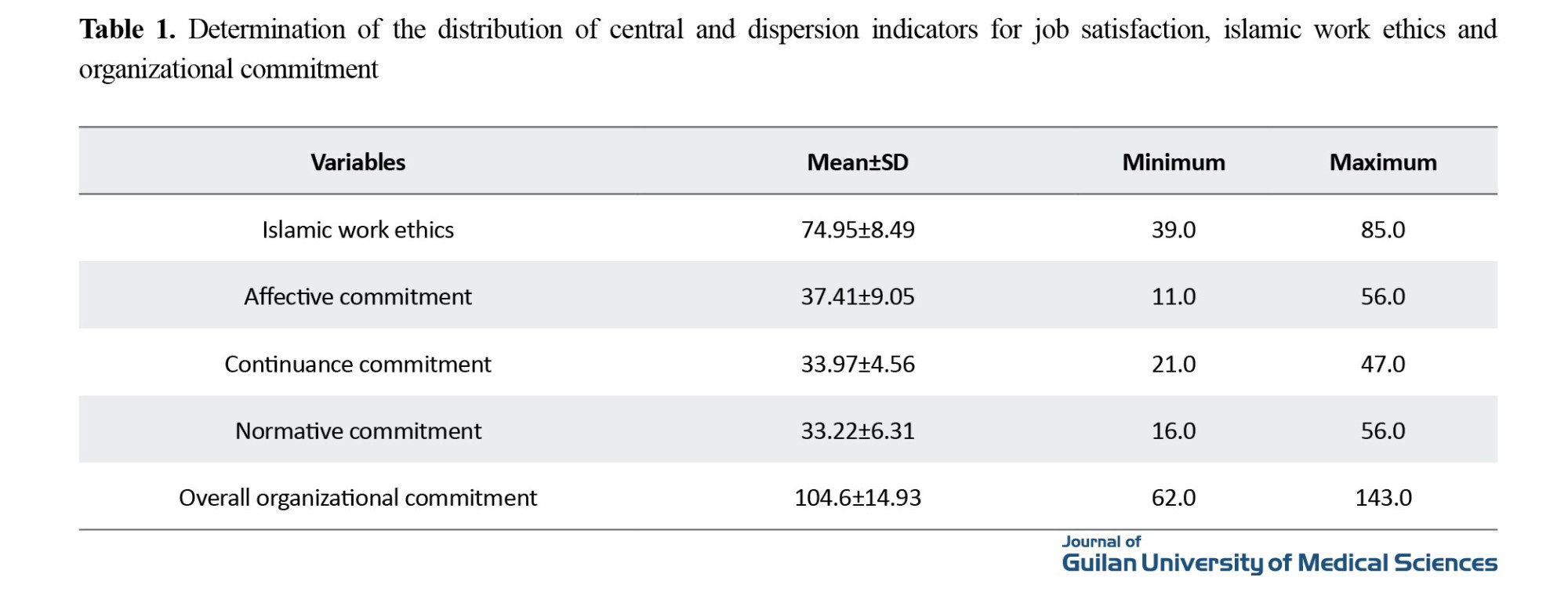
The Mean±SD of Islamic work ethics scores were 74.95±8.49, while the Mean±SD of total organizational commitment and its dimensions (affective, continuance, and normative) were 104.6±14.93, 37.41±9.05, 33.97±4.56 and 33.22±6.3, respectively. The results are shown in Table 1.
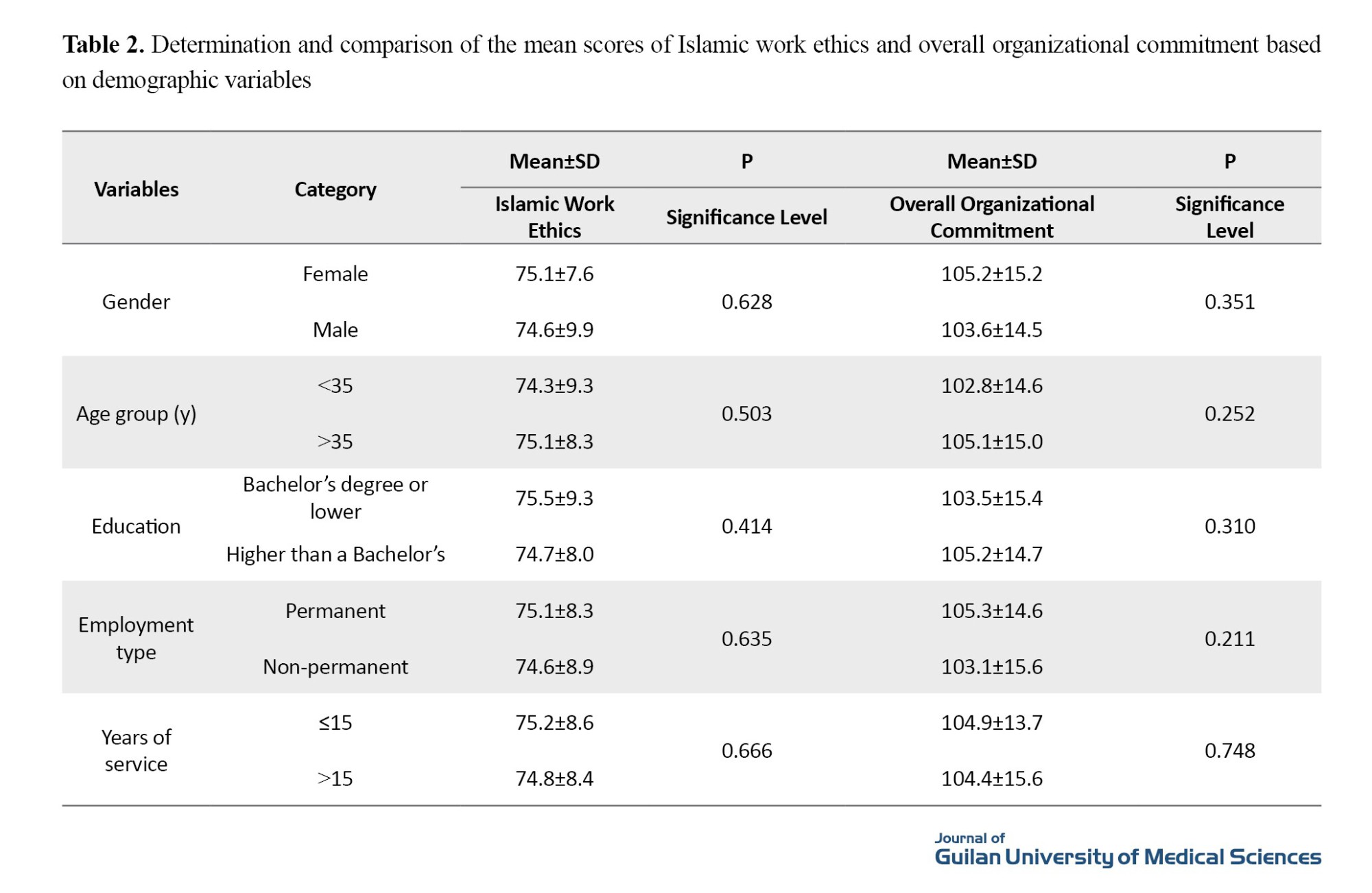
The mean and standard deviation of job satisfaction were 66.3±10.95. In the comparative analysis of the relationship between the mean scores of Islamic work ethics and the mean scores of organizational commitment and each of its dimensions with each of the demographic variables, no statistically significant relationship was observed (P>0.05). Therefore, there is no statistically significant relationship between the mean scores of Islamic work ethics and the mean scores of organizational commitment and each of its dimensions with any of the variables of gender, age group, education, type of employment, and years of service. The results are presented in Table 2. In the comparative analysis of the relationship between the mean scores of Islamic work ethics and the mean scores of organizational commitment and each of its dimensions with each of the demographic variables, no statistically significant relationship was observed (P>0.05). Therefore, there is no statistically significant relationship between the mean scores of Islamic work ethics and the mean scores of organizational commitment and each of its dimensions with any of the variables of gender, age group, education, type of employment, and years of service. The results are presented in Table 2.
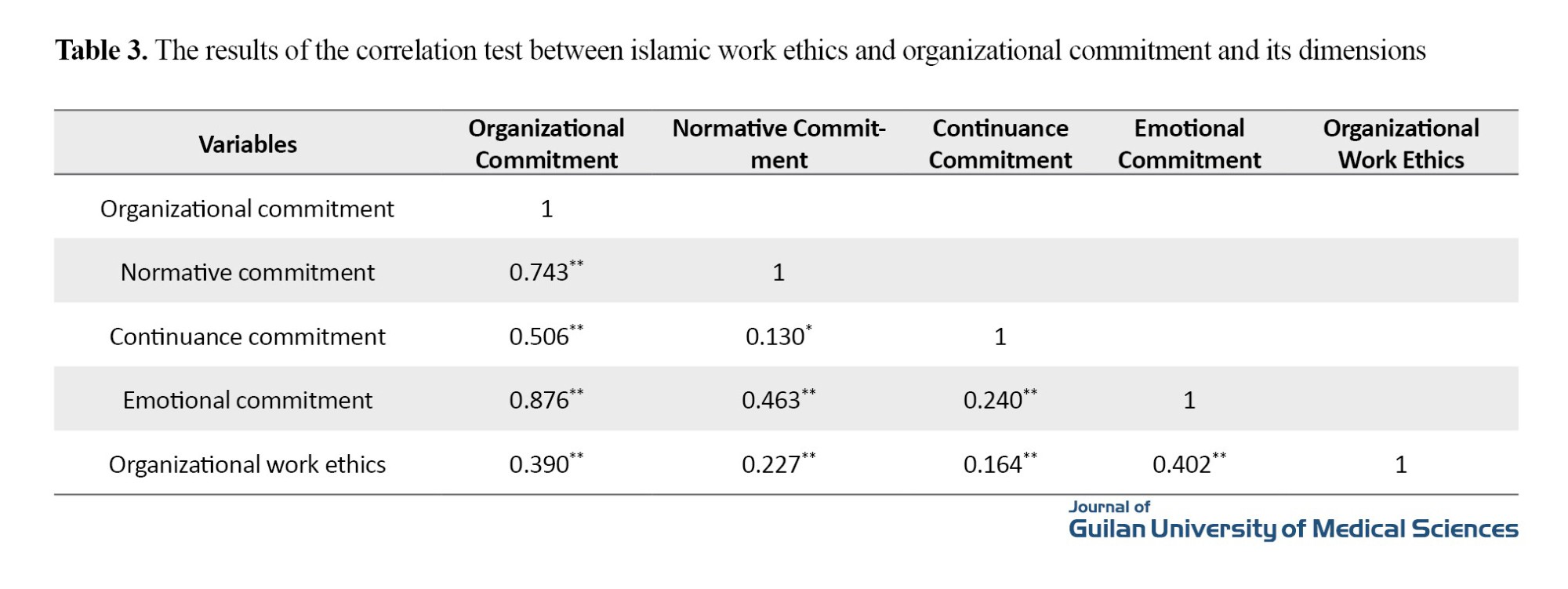
A statistically significant positive correlation was observed between organizational commitment and each of its dimensions with Islamic work ethics (P<0.001). The strongest correlation was found between affective commitment and Islamic work ethics (correlation coefficient=0.402; P<0.001), while the weakest correlation was between continuance commitment and Islamic work ethics (correlation coefficient=0.164; P<0.001) (Table 3).
To identify the factors influencing organizational commitment scores, variables such as gender, age group, employment type, years of service, education level, job satisfaction score and Islamic work ethics were entered into a univariate linear regression model. The results showed that only Islamic work ethics and job satisfaction had a significant effect on organizational commitment scores (P<0.001). Additionally, in a multivariate linear regression model, where all variables were entered simultaneously, only Islamic work ethics and job satisfaction, under the same conditions in terms of other variables entered into the model, were significantly associated with organizational commitment scores (P<0.001). Job satisfaction had a stronger relationship with organizational commitment (correlation coefficient=0.657) compared to Islamic work ethics (correlation coefficient=0.389; P<0.001) (Table 4).

Conclusion
The findings from employees in the various vice chancellors (cultural, health, development, research and technology, education, treatment, food and drug) at Guilan University of Medical Sciences indicate a positive relationship between Islamic work ethics and organizational commitment. High scores in job satisfaction and Islamic work ethics suggest that employees not only enjoy job satisfaction but also adhere to the principles of Islamic work ethics. Furthermore, the average organizational commitment scores and their dimensions indicate that employees at this university exhibit a medium-to-high level of organizational commitment. The low score in normative commitment suggests that employees do not remain with the organization out of a sense of duty to the organization itself, but rather because they lack better alternatives for work outside the organization, therefore compelled to stay.
Ethical Considerations
Compliance with ethical guidelines
This study was approved by the Research Ethics Committee of Guilan University of Medical Sciences, Rasht, Iran (Code: IR.GUMS.REC.1400.542).
Funding
This study was supported by the Vice Chancellor for Research and Technology, Guilan University of Medical Sciences, Rasht City, Iran.
Authors contributions
Conceptualization, editing & review: Mitra Abolhasanpour Chelaras and Morteza Rahbar Taramsari; Preparing the initial draft, resources, project administration, and funding acquisition: Mitra Abolhasanpour Chelaras; Editing & review, validation, and supervision: Morteza Rahbar Taramsari; Methodology and Statistical analysis: Maryam Ghalandari and Habib Eslami Kenarsari; investigation: All authors.
Conflicts of interest
The authors declared no conflict of interest.
Acknowledgment
The authors would like to thank the Deputy for Research of Guilan University of Medical Sciences and all participants for their support and cooperation in this study.
References
Work ethic is one of the most critical topics in contemporary organizations, receiving particular attention from management, as it plays a pivotal role in increasing employees’ behavioral commitment in the workplace. Organizations are particularly keen on attracting individuals with proper ethical values, as the ethical framework of an organization is shaped by its employees. Islamic work ethics have a profound impact on organizational commitment, suggesting that the implementation of Islamic ethical principles can contribute significantly to fostering a high level of commitment among employees to the organization. The reason organizational commitment has drawn considerable interest from researchers is that it influences employee behavior within organizations and impacts various organizational variables, including turnover intentions, job performance, absenteeism, as well as job-related conflict and stress. It is also a determining factor in whether employees stay with or leave the organization. Many behaviors and actions of managers and employees are rooted in moral values and are directly influenced by ethics. In organizations, particularly in societies such as Iran, where there is a strong tradition of ethical values but also a significant gap from developed countries, neglecting work ethics can create serious challenges for organizations and undermine their legitimacy and effectiveness. This paper highlights the importance of studying work ethics and how to establish them in the hearts and minds of employees, as the lack of ethics in an organization leads to an inefficient and weak administrative system, unable to respond effectively to the needs of customers and stakeholders. Accordingly, this study investigates the relationship between Islamic work ethics and organizational commitment among the employees of Guilan University of Medical Sciences during the years 2011-2012.
Methods
This study was conducted as cross-sectional research over six months. A total of 353 employees from various departments of Guilan University of Medical Sciences were selected through proportional stratified sampling. The data collection tools included the Islamic work ethics questionnaire by Ali and Al-Kazemi (1988), Allen and Meyer’s organizational commitment scale, and a job satisfaction scale. The validity of the questionnaires was assessed by experts, and their reliability was evaluated based on the Cronbach α coefficient. Data analysis was conducted using independent t tests, Pearson correlation analysis, and univariate and multivariate linear regression.
Results
The Mean±SD of Islamic work ethics scores were 74.95±8.49, while the Mean±SD of total organizational commitment and its dimensions (affective, continuance, and normative) were 104.6±14.93, 37.41±9.05, 33.97±4.56 and 33.22±6.3, respectively. The results are shown in Table 1.
The mean and standard deviation of job satisfaction were 66.3±10.95. In the comparative analysis of the relationship between the mean scores of Islamic work ethics and the mean scores of organizational commitment and each of its dimensions with each of the demographic variables, no statistically significant relationship was observed (P>0.05). Therefore, there is no statistically significant relationship between the mean scores of Islamic work ethics and the mean scores of organizational commitment and each of its dimensions with any of the variables of gender, age group, education, type of employment, and years of service. The results are presented in Table 2. In the comparative analysis of the relationship between the mean scores of Islamic work ethics and the mean scores of organizational commitment and each of its dimensions with each of the demographic variables, no statistically significant relationship was observed (P>0.05). Therefore, there is no statistically significant relationship between the mean scores of Islamic work ethics and the mean scores of organizational commitment and each of its dimensions with any of the variables of gender, age group, education, type of employment, and years of service. The results are presented in Table 2.
A statistically significant positive correlation was observed between organizational commitment and each of its dimensions with Islamic work ethics (P<0.001). The strongest correlation was found between affective commitment and Islamic work ethics (correlation coefficient=0.402; P<0.001), while the weakest correlation was between continuance commitment and Islamic work ethics (correlation coefficient=0.164; P<0.001) (Table 3).
To identify the factors influencing organizational commitment scores, variables such as gender, age group, employment type, years of service, education level, job satisfaction score and Islamic work ethics were entered into a univariate linear regression model. The results showed that only Islamic work ethics and job satisfaction had a significant effect on organizational commitment scores (P<0.001). Additionally, in a multivariate linear regression model, where all variables were entered simultaneously, only Islamic work ethics and job satisfaction, under the same conditions in terms of other variables entered into the model, were significantly associated with organizational commitment scores (P<0.001). Job satisfaction had a stronger relationship with organizational commitment (correlation coefficient=0.657) compared to Islamic work ethics (correlation coefficient=0.389; P<0.001) (Table 4).
Conclusion
The findings from employees in the various vice chancellors (cultural, health, development, research and technology, education, treatment, food and drug) at Guilan University of Medical Sciences indicate a positive relationship between Islamic work ethics and organizational commitment. High scores in job satisfaction and Islamic work ethics suggest that employees not only enjoy job satisfaction but also adhere to the principles of Islamic work ethics. Furthermore, the average organizational commitment scores and their dimensions indicate that employees at this university exhibit a medium-to-high level of organizational commitment. The low score in normative commitment suggests that employees do not remain with the organization out of a sense of duty to the organization itself, but rather because they lack better alternatives for work outside the organization, therefore compelled to stay.
Ethical Considerations
Compliance with ethical guidelines
This study was approved by the Research Ethics Committee of Guilan University of Medical Sciences, Rasht, Iran (Code: IR.GUMS.REC.1400.542).
Funding
This study was supported by the Vice Chancellor for Research and Technology, Guilan University of Medical Sciences, Rasht City, Iran.
Authors contributions
Conceptualization, editing & review: Mitra Abolhasanpour Chelaras and Morteza Rahbar Taramsari; Preparing the initial draft, resources, project administration, and funding acquisition: Mitra Abolhasanpour Chelaras; Editing & review, validation, and supervision: Morteza Rahbar Taramsari; Methodology and Statistical analysis: Maryam Ghalandari and Habib Eslami Kenarsari; investigation: All authors.
Conflicts of interest
The authors declared no conflict of interest.
Acknowledgment
The authors would like to thank the Deputy for Research of Guilan University of Medical Sciences and all participants for their support and cooperation in this study.
References
- Hanaysha J. Examining the effects of employee empowerment, teamwork, and employee training on organizational commitment. Procedia-Social and Behavioral Sciences. 2016; 229:298-306. [DOI:10.1016/j.sbspro.2016.07.140]
- Al-Maamari QA, Raju V. Does organizational commitment affect individual readiness for Total Quality Management (TQM) Implementation. Test Enginering & Management. 2020; 7:47-62. [Link]
- Bhat SU. Concept of ethics in Islam: A conceptual study in the light of Quran and Sunnah. Al-Qasemi Journal of Islamic Studies. 2017; 2(1):145-54. [DOI:10.12816/0051424]
- Ansari ME, Ardakani MS. [Islamic work ethics and organizational commitment among employees of Isfahan University of Medical Sciences (Persian)]. Iranian Journal of Medical Ethics and History of Medicine. 2013; 6(2):86-98. [Link]
- Ali AJ, Al‐Owaihan A. Islamic work ethic: A critical review. Cross Cultural Management: An International Journal. 2008; 15(1):5-19. [DOI:10.1108/13527600810848791]
- Ali AJ, Al‐Kazemi AA. Islamic work ethic in Kuwait. Cross Cultural Management: An International Journal. 2007; 14(2):93-104. [DOI:10.1108/13527600710745714]
- Rokhman W. The effect of Islamic work ethics on work outcomes. EJBO-Electronic Journal of Business Ethics and Organization Studies. 2010. [Link]
- Manan SK, Kamaluddin N, Puteh Salin AS. Islamic work ethics and organizational commitment: Evidence from Employees of Banking Institutions in Malaysia. Pertanika Journal of Social Sciences & Humanities. 2013; 21(4):1471-89. [Link]
- Vakola M, Nikolaou I. Attitudes towards organizational change: What is the role of employees’ stress and commitment? Employee Relations. 2005; 27(2):160-74. [DOI:10.1108/01425450510572685]
- Salami SO. Demographic and psychological factors predicting organizational commitment among industrial workers. The Anthropologist. 2008; 10(1):31-8. [DOI:10.1080/09720073.2008.11891026]
- Mooghali A, Hassanpoor A, Hassanpoor M. [Surveying of the relationship between employee empowerment and organizational commitment in the 19 Districts of Tehran Education Organization (Persian)]. Journal of Public Administration. 2009; 1(2):119-32. [Link]
- Marri MY, Sadozai AM, Zaman HM, Ramay MI. The impact of Islamic work ethics on job satisfaction and organizational commitment: A study of agriculture sector of Pakistan. International Journal of Business and Behavioral Sciences. 2012; 2(12):32-45. [Link]
- Alrubaishi D, McAdam M, Harrison R. Culture, convention, and continuity: Islam and family firm ethical behavior. Business Ethics, the Environment & Responsibility. 2021; 30(2):202-15. [DOI:10.1111/beer.12328]
- Frone MR. What happened to the employed during the Great Recession? A US population study of net change in employee insecurity, health, and organizational commitment. Journal of Vocational Behavior. 2018; 107:246-60. [DOI:10.1016/j.jvb.2018.05.001] [PMID]
- Gol Paror M, Nadi Mohammad A. [Mediating role of organizational loyalty in relation between work ethic with deviant workplace behavior (Persian)]. Ethics in Science and Technology. 2011; 6(1):43-53. [Link]
- Jovanmard SS. [Identifying the relationship between organizational commitment, upon entering and after entering the organization and its relationship with performance (case study: Qazvin University of Medical Sciences) (Persian)]. Development and Transformation Management Quarterly. 2011; 8(4):35-45. [Link]
- Yusof QB, Yusof NS, Abbas RB. the effect of Islamic work ethics on job satisfaction in organization; a study in Sekolah Rendah Islam Indera Mahkota (Sri Abim), Kuantan. Journal of Global Business and Social Entrepreneurship (GBSE). 2017; 1(3):46-61. [Link]
- Chye Koh H, Boo EfH. Organisational ethics and employee satisfaction and commitment. Management Decision. 2004; 42(5):677-93. [DOI:10.1108/00251740410538514]
- Okpara JO, Wynn P. The impact of ethical climate on job satisfaction, and commitment in Nigeria: Implications for management development. Journal of Management Development. 2008; 27(9):935-50. [DOI:10.1108/02621710810901282]
- Rokhman W. Islamic work ethic as an antecedent of work outcomes: A study of Islamic microfinance in Central Java, Indonesia. QIJIS (Qudus International Journal of Islamic Studies). 2016; 2(1):82-97. [Link]
- Nasution FN, Rafiki A. Islamic work ethics, organizational commitment and job satisfaction of Islamic banks in Indonesia. RAUSP Management Journal. 2020; 55(2):195-205. [DOI:10.1108/RAUSP-01-2019-0011]
- Mooghali A, Seyedjavadin SR, Ahmadi SAA, Alavi A. [An explanatory model of Islamic work ethics and organizational citizenship behavior due to job values: Case study of Isfahan University of Medical Sciences, Iran (Persian)]. Director General. 2013; 10(2):302-11. [Link]
- Moeidfar S. [Work behavior and the influential factors among employees (Persian)]. Journal-Social Welfare Research. 2006; 6(23):321-41. [Link]
- Meriac JP, Poling TL, Woehr DJ. Are there gender differences in work ethic? An examination of the measurement equivalence of the multidimensional work ethic profile. Personality and Individual Differences. 2009; 47(3):209-13. [DOI:10.1016/j.paid.2009.03.001]
- Dabbagh Manesh S, Moogheli A, Mohammad Jani MR. [Investigating the organizational factors affecting employees’ Islamic work ethics (Study case: Fars Province social security organization employees) (Persian)]. Paper presented at: The 2nd National Conference on Modern Research in Management and Law. 12 July 2018; Kazerun, Iran. [Link]
Review Paper: Research |
Subject:
General
Received: 2024/01/23 | Accepted: 2024/12/24 | Published: 2025/07/1
Received: 2024/01/23 | Accepted: 2024/12/24 | Published: 2025/07/1
| Rights and permissions | |
 |
This work is licensed under a Creative Commons Attribution-NonCommercial 4.0 International License. |

Copyright © The Author(s);
This is an open access article distributed under the terms of the
Creative Commons Attribution License (CC-By-NC),which permits use, distribution, and reproduction in any medium,
provided the original work is properly cited and is not used forcommercial purposes.
Contact Information