

Volume 34, Issue 3 (10-2025)
JGUMS 2025, 34(3): 266-277 |
Back to browse issues page


Research code: https://ethics.research.ac.ir/IR.GUMS.REC.1401.278
Ethics code: https://ethics.research.ac.ir/IR.GUMS.REC.1401.278


Download citation:
BibTeX | RIS | EndNote | Medlars | ProCite | Reference Manager | RefWorks
Send citation to:


BibTeX | RIS | EndNote | Medlars | ProCite | Reference Manager | RefWorks
Send citation to:
Davoudi Kiakalayeh A, Noori Roodsari N, Taromi M J, Homaie Rad E, Davoudi Kiakalayeh S, Kouchakinejad L. Regional Burden of Child Drowning in Guilan Province, North of Iran, During 2017-2021. JGUMS 2025; 34 (3) :266-277
URL: http://journal.gums.ac.ir/article-1-2695-en.html
URL: http://journal.gums.ac.ir/article-1-2695-en.html
Ali Davoudi Kiakalayeh *1 

 , Nazanin Noori Roodsari2 , Mohammad javad Taromi3 , Enayatollah Homaie Rad4 , Sajad Davoudi Kiakalayeh3 , Leila Kouchakinejad3
, Nazanin Noori Roodsari2 , Mohammad javad Taromi3 , Enayatollah Homaie Rad4 , Sajad Davoudi Kiakalayeh3 , Leila Kouchakinejad3
1- Department of Preventive and Social Medicine, School of Medicine,Trauma Institute, Guilan University of Medical Sciences, Rasht, Iran.
2- Department of Emergency Medicine, School of Medicine, Guilan University of Medical Sciences, Rasht, Iran.
3- Guilan Road Trauma Research Center, Guilan University of Medical Sciences. Rasht, Iran.
4- Social Determinants of Health Research Center, Guilan University of Medical Sciences, Rasht, Iran.
2- Department of Emergency Medicine, School of Medicine, Guilan University of Medical Sciences, Rasht, Iran.
3- Guilan Road Trauma Research Center, Guilan University of Medical Sciences. Rasht, Iran.
4- Social Determinants of Health Research Center, Guilan University of Medical Sciences, Rasht, Iran.
Full-Text [PDF 3988 kb]
(177 Downloads)
| Abstract (HTML) (1264 Views)
Full-Text: (196 Views)
Introduction
Drowning is the third leading cause of unintentional death worldwide. In many developed countries, it is the second leading cause of death in children under 15 years of age, following traffic accidents. The incidence of drowning in children varies across countries. Previous studies have shown that most fatal drownings occur in low- and middle-income countries. In Iran, the annual incidence of drowning deaths in children under 15 years of age is 6.12 per 100000 population, although this may be underestimated. The common locations of drowning vary by age. In children under one year of age, home swimming pools, especially bathtubs, are common sites, while in adolescents aged 15-19, natural waters such as streams, rivers, and lakes are more frequent locations for drowning. Drowning occurs most frequently on weekends and in the summertime months. The aim of this study is to determine the regional burden of child drowning in Guilan Province, Iran, that occurred during 2017-2021.
Methods
This descriptive and retrospective study was conducted using the data obtained from the national drowning registration system. The data of children under 15 years of age who experienced drowning events (fatal and non-fatal) were extracted using a checklist and analyzed using the autoregressive moving average (ARMA) time series model. Fatal drowning data was collected from the death certificates, local police stations, and hospitals. Non-fatal drowning data were obtained from the emergency medical services (EMS) center, the Red Crescent Society, the municipality, fire departments, and the Lifesaving Society.
Results
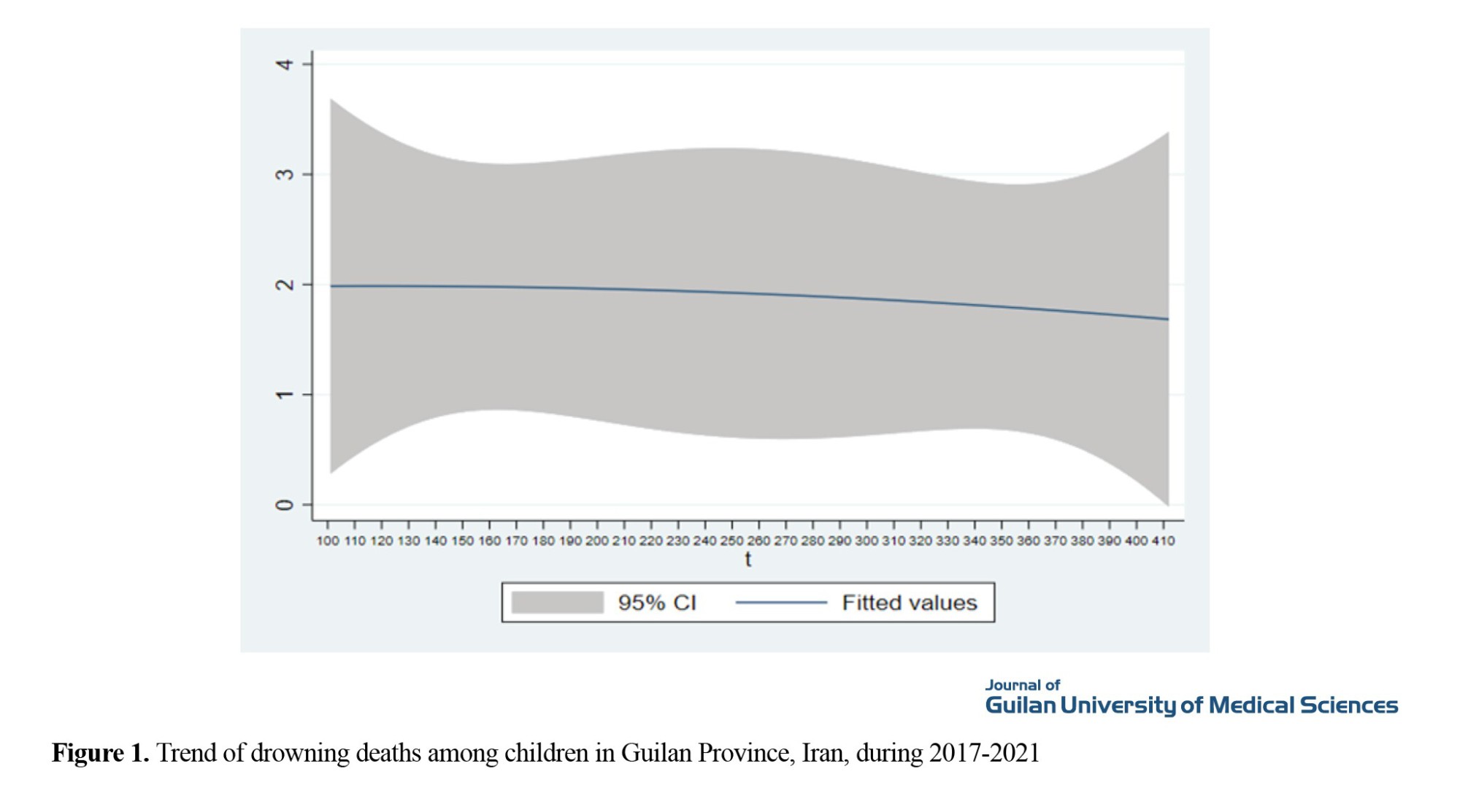
In this study, data from 106 children who experienced drowning events during the study period were analyzed. In terms of gender, 71 were boys (67%) and 35 were girls (30%). The majority was in the age group of 11-15 years (54.7%), followed by age groups of 6-10 (27.3%) and <5 (18%) years. Regarding the drowning location, the most prevalent site was the sea (66%), followed by rivers (11.3%). Out of 106 drowning cases, 51 (48.1%) were treated by the EMS, 34 (32%) by the Red Crescent Society, 20 (19%) by the Legal Medicine Organization, and only one case by the fire departments. Also, most of drowning accidents occurred in the summertime months (July, July, and August), while the least occurred in the wintertime months (December, January, and February). Regarding the time of drowning incidents, the highest number of incidents occurred from 12:00 to 20:00 (56.6%), followed by 20:00 to 8:00 ( 32.1%) and 8:00 to 12:00 (11.3%). During the five years of study, 63 (59.5%) children died due to drowning, of whom 39 died at the scene. Analysis of the data using the ARMA model plotted in Figure 1 for drowning incidents in children under 15 years revealed a slow decrease in the number of drowning deaths during the study period.
Conclusion
There were 106 drowning cases among children in Guilan Province, Iran, during 2017-2021, including 67% boys and 33% girls, mostly aged 11-15 years (54.7%). Most drowning accidents occurred in the sea (66%) and rivers (11.3%). This highlights the importance of increasing the number of lifeguards on beaches and providing continuous training to them. Additionally, developing pre-hospital emergency centers and Red Crescent facilities on beaches and in natural aquatic environments is essential in Guilan province. The time-series analysis indicated that the number of drowning deaths in children had a downward trend from 2017 to 2021. This suggests that the COVID-19 pandemic did not affect the death trend.
Ethical Considerations
Compliance with ethical guidelines
This study was approved by the Ethics Committee of Guilan University of Medical Sciences, Rasht, Iran (Code: IR.GUMS.REC.1401.278).
Funding
This study was financially supported by the Guilan University of Medical Sciences, Rasht, Iran.
Authors contributions
Conceptualization, methodology, editing & review, and validation: Ali Davoudi Kiakalayeh and Nazanin Noori Roodsari; Data collection and data analysis: Ali Davoudi Kiakalayeh, Mohammad Javad Taromi, and Leila Kouchakinejad; Drafting of the manuscript: Ali Davoudi Kiakalayeh and Sajad Davoudi Kiakalayeh; visualization and supervision: Enayatollah Homaie Rad and Sajad Davoudi Kiakalayeh; Funding acquisition, and project management: Ali Davoudi Kiakalayeh and Leila Kouchakinejad.
Conflicts of interest
The authors declare no conflict of interest.
Acknowledgments
The authors would like to thank the staff of the Guilan Red Crescent Society, the National Emergency Medical Organization, and the Legal Medicine Organization for their assistance, and the Vice-Chancellor for Research and Technology of Guilan University of Medical Sciences for the financial support.
Drowning is the third leading cause of unintentional death worldwide. In many developed countries, it is the second leading cause of death in children under 15 years of age, following traffic accidents. The incidence of drowning in children varies across countries. Previous studies have shown that most fatal drownings occur in low- and middle-income countries. In Iran, the annual incidence of drowning deaths in children under 15 years of age is 6.12 per 100000 population, although this may be underestimated. The common locations of drowning vary by age. In children under one year of age, home swimming pools, especially bathtubs, are common sites, while in adolescents aged 15-19, natural waters such as streams, rivers, and lakes are more frequent locations for drowning. Drowning occurs most frequently on weekends and in the summertime months. The aim of this study is to determine the regional burden of child drowning in Guilan Province, Iran, that occurred during 2017-2021.
Methods
This descriptive and retrospective study was conducted using the data obtained from the national drowning registration system. The data of children under 15 years of age who experienced drowning events (fatal and non-fatal) were extracted using a checklist and analyzed using the autoregressive moving average (ARMA) time series model. Fatal drowning data was collected from the death certificates, local police stations, and hospitals. Non-fatal drowning data were obtained from the emergency medical services (EMS) center, the Red Crescent Society, the municipality, fire departments, and the Lifesaving Society.
Results
In this study, data from 106 children who experienced drowning events during the study period were analyzed. In terms of gender, 71 were boys (67%) and 35 were girls (30%). The majority was in the age group of 11-15 years (54.7%), followed by age groups of 6-10 (27.3%) and <5 (18%) years. Regarding the drowning location, the most prevalent site was the sea (66%), followed by rivers (11.3%). Out of 106 drowning cases, 51 (48.1%) were treated by the EMS, 34 (32%) by the Red Crescent Society, 20 (19%) by the Legal Medicine Organization, and only one case by the fire departments. Also, most of drowning accidents occurred in the summertime months (July, July, and August), while the least occurred in the wintertime months (December, January, and February). Regarding the time of drowning incidents, the highest number of incidents occurred from 12:00 to 20:00 (56.6%), followed by 20:00 to 8:00 ( 32.1%) and 8:00 to 12:00 (11.3%). During the five years of study, 63 (59.5%) children died due to drowning, of whom 39 died at the scene. Analysis of the data using the ARMA model plotted in Figure 1 for drowning incidents in children under 15 years revealed a slow decrease in the number of drowning deaths during the study period.
Conclusion
There were 106 drowning cases among children in Guilan Province, Iran, during 2017-2021, including 67% boys and 33% girls, mostly aged 11-15 years (54.7%). Most drowning accidents occurred in the sea (66%) and rivers (11.3%). This highlights the importance of increasing the number of lifeguards on beaches and providing continuous training to them. Additionally, developing pre-hospital emergency centers and Red Crescent facilities on beaches and in natural aquatic environments is essential in Guilan province. The time-series analysis indicated that the number of drowning deaths in children had a downward trend from 2017 to 2021. This suggests that the COVID-19 pandemic did not affect the death trend.
Ethical Considerations
Compliance with ethical guidelines
This study was approved by the Ethics Committee of Guilan University of Medical Sciences, Rasht, Iran (Code: IR.GUMS.REC.1401.278).
Funding
This study was financially supported by the Guilan University of Medical Sciences, Rasht, Iran.
Authors contributions
Conceptualization, methodology, editing & review, and validation: Ali Davoudi Kiakalayeh and Nazanin Noori Roodsari; Data collection and data analysis: Ali Davoudi Kiakalayeh, Mohammad Javad Taromi, and Leila Kouchakinejad; Drafting of the manuscript: Ali Davoudi Kiakalayeh and Sajad Davoudi Kiakalayeh; visualization and supervision: Enayatollah Homaie Rad and Sajad Davoudi Kiakalayeh; Funding acquisition, and project management: Ali Davoudi Kiakalayeh and Leila Kouchakinejad.
Conflicts of interest
The authors declare no conflict of interest.
Acknowledgments
The authors would like to thank the staff of the Guilan Red Crescent Society, the National Emergency Medical Organization, and the Legal Medicine Organization for their assistance, and the Vice-Chancellor for Research and Technology of Guilan University of Medical Sciences for the financial support.
References
- Ahlm K, Saveman BI, Björnstig U. Drowning deaths in Sweden with emphasis on the presence of alcohol and drugs - A retrospective study, 1992-2009. BMC Public Health. 2013; 13:216. [DOI:10.1186/1471-2458-13-216] [PMID] [PMCID]
- Guevarra JP, Franklin RC, Basilio JA, Orbillo LL, Go JJ. Child drowning prevention in the Philippines: The beginning of a conversation. International Journal of Injury Control and Safety Promotion. 2015; 22(3):243-53. [DOI:10.1080/17457300.2014.912235] [PMID]
- Burford AE, Ryan LM, Stone BJ, Hirshon JM, Klein BL. Drowning and near-drowning in children and adolescents: A succinct review for emergency physicians and nurses. Pediatric Emergency Care. 2005; 21(9):610-6. [DOI:10.1097/01.pec.0000177204.21774.35] [PMID]
- Davoudi-kiakalayeh A, Mohammadi R, Yousefzade-Chabok S, Jansson B. Evaluation of a community-based drowning prevention programme in northern Islamic Republic of Iran.Eastern Mediterranean Health Journal. 2013; 19(7):629-37. [DOI:10.26719/2013.19.7.629]
- Papa L, Hoelle R, Idris A. Systematic review of definitions for drowning incidents. Resuscitation. 2005; 65(3):255-64. [DOI:10.1016/j.resuscitation.2004.11.030] [PMID]
- World Health Organization (WHO). Drowning. 2024 [Updated 2024 December 13]. Available from: [Link]
- Institute for Health Metrics and Evaluation. The global burden of diseases: Generating evidence, guiding policy. Washington: Institute for Health Metrics and Evaluation; 2013. [Link]
- Leavy JE, Crawford G, Leaversuch F, Nimmo L, McCausland K, Jancey J. A review of drowning prevention interventions for children and young people in high, low and middle income countries. Journal of Community Health. 2016; 41(2):424-41. [DOI:10.1007/s10900-015-0105-2] [PMID]
- Zhang GP. Time series forecasting using a hybrid ARIMA and neural network model. Neurocomputing. 2003; 50:159-75. [DOI:10.1016/S0925-2312(01)00702-0]
- Movahedian AH, Mosayebi Z, Taghavi A, Fallahi AH, Mousavi SG. [An epidemiologic survey on drowning and near-drowning in children and adolescents admitted in Kashan Beheshti Hospital during 1993-2005 (Persian)]. Feyz Medical Sciences Journal. 2009 Jan 10;12(5):16-20. [Link]
- Al-Mofadda SM, Nassar A, Al-Turki A, Al-Sallounm AA. Pediatric near drowning: The experience of King Khalid University Hospital. Annals of Saudi Medicine. 2001; 21(5-6):300-3. [DOI:10.5144/0256-4947.2001.300] [PMID]
- Susiva C, Boonrong T. Near-drowning in pediatric respiratory intensive care unit, Siriraj hospital.The Journal of the Medical Association of Thailand. 2005; 88(Suppl 8):S44-7. [Link]
- Ross FI, Elliott EJ, Lam LT, Cass DT. Children under 5 years presenting to paediatricians with near-drowning. Journal of Paediatrics and Child Health. 2003; 39(6):446-50. [DOI:10.1046/j.1440-1754.2003.00186.x] [PMID]
- Davoudi-Kiakalayeh A, Dalal K, Yousefzade-Chabok S, Jansson B, Mohammadi R. Costs related to drowning and near drowning in northern Iran (Guilan province). Ocean & Coastal Management. 2011; 54(3):250-5. [DOI:10.1016/j.ocecoaman.2010.12.004]
- Davoudi-Kiakalayeh A, Mohammadi R, Yousefzadeh-Chabok S. Prevention of drowning by community-based intervention: Implications for low- and middle- income countries. Archives of Trauma Research. 2012; 1(3):112-7. [DOI:10.5812/atr.7690] [PMID] [PMCID]
- Wang L, Cheng X, Yin P, Cheng P, Liu Y, Schwebel DC, et al. Unintentional drowning mortality in China, 2006-2013. Injury Prevention. 2019; 25(1):47-51. [DOI:10.1136/injuryprev-2017-042713] [PMID] [PMCID]
- Sekii H, Ohtsu T, Shirasawa T, Ochiai H, Shimizu T, Kokaze A. Childhood mortality due to unintentional injuries in Japan, 2000–2009. International Journal of Environmental Research and Public Health. 2013; 10(2):528-40. [DOI:10.3390/ijerph10020528] [PMID] [PMCID]
- Meddings DR, Scarr JP, Larson K, Vaughan J, Krug EG. Drowning prevention: Turning the tide on a leading killer. Lancet Public Health. 2021; 6(9):e692-5. [DOI:10.1016/S2468-2667(21)00165-1] [PMID]
- Abdullah SH, Flora MS. Non- fatal drowning in under- five rural children of Bangladesh. Ibrahim Medical College Journal. 2015; 9(2):37-41. [DOI:10.3329/imcj.v9i2.28851]
- Kiakalayeh AD, Mohammadi R, Ekman DS, Chabok SY, Janson B. Unintentional drowning in northern Iran: A population-based study. Accident; Analysis and Prevention. 2008; 40(6):1977-81. [DOI:10.1016/j.aap.2008.08.008] [PMID]
- Lee LK, Mao C, Thompson KM. Demographic factors and their association with outcomes in pediatric submersion injury. Academic Emergency Medicine. 2006; 13(3):308-13. [DOI:10.1197/j.aem.2005.10.012] [PMID]
- Akbarpour S, Jafari N, Khosravi A, Soori H. [Pattern of drowning and its burden in northern provinces of Iran (Gilan and Mazandaran) in 2008 (Persian)]. Iranian Journal of Epidemiology. 2011; 7(2):38-43. [Link]
- Mahony A, Barnsley P, Peden AE, Scarr J. A thirteen year national study of non-fatal drowning in Australia: Data challenges, hidden impacts and social costs. Sydney: Royal Life Saving Society Australia; 2017. [Link]
Review Paper: Research |
Subject:
General
Received: 2024/04/2 | Accepted: 2025/02/16 | Published: 2025/10/2
Received: 2024/04/2 | Accepted: 2025/02/16 | Published: 2025/10/2
| Rights and permissions | |
 |
This work is licensed under a Creative Commons Attribution-NonCommercial 4.0 International License. |

Copyright © The Author(s);
This is an open access article distributed under the terms of the
Creative Commons Attribution License (CC-By-NC),which permits use, distribution, and reproduction in any medium,
provided the original work is properly cited and is not used forcommercial purposes.
Contact Information