

Volume 30, Issue 1 (4-2021)
JGUMS 2021, 30(1): 64-75 |
Back to browse issues page


Ethics code: IRCT 2016011622984N1


Download citation:
BibTeX | RIS | EndNote | Medlars | ProCite | Reference Manager | RefWorks
Send citation to:


BibTeX | RIS | EndNote | Medlars | ProCite | Reference Manager | RefWorks
Send citation to:
Mehrabia F, Farmanbar R, Mahdavi Roshan M, Farzan R, Omidi S, Aghebati R. Effect of an Intervention Based on the Theory of Planned Behavior on Self-Care Behavior of Patients With Hypertension: A Clinical Trial. JGUMS 2021; 30 (1) :64-75
URL: http://journal.gums.ac.ir/article-1-2344-en.html
URL: http://journal.gums.ac.ir/article-1-2344-en.html
Fardin Mehrabia1 

 , Rabiollah Farmanbar1 , Marjan Mahdavi Roshan2 , Ramyar Farzan3 , Saeid Omidi1 , Roghayeh Aghebati *1
, Rabiollah Farmanbar1 , Marjan Mahdavi Roshan2 , Ramyar Farzan3 , Saeid Omidi1 , Roghayeh Aghebati *1
1- Department of Health Training and Enhancement, Faculty of Health, Guilan Medical University, Rasht, Iran.
2- Department of Cardiology, Heshmat Hospital, Guilan Interventional Cardiovascular Research Center, School of Medicine, Guilan University of Medical Sciences, Rasht, Iran.
3- Department of Plastic & Reconstructive Surgery, School of Medicine, Guilan University of Medical Sciences, Rasht, Iran.
2- Department of Cardiology, Heshmat Hospital, Guilan Interventional Cardiovascular Research Center, School of Medicine, Guilan University of Medical Sciences, Rasht, Iran.
3- Department of Plastic & Reconstructive Surgery, School of Medicine, Guilan University of Medical Sciences, Rasht, Iran.
Full-Text [PDF 4433 kb]
(1538 Downloads)
| Abstract (HTML) (2461 Views)
Full-Text: (2762 Views)
1. Introduction
Cardiovascular diseases account for to a significant rate of mortalities in the world and are the most important causes of mortality in the United States [1]. Hypertension is one of the most important risk factors for cardiovascular patients [2, 3] whose prevalence increases by increase of age [4]. It is one of the general health problems worldwide. Hypertension is defined as a systolic blood pressure of 140 mmHg and higher and diastolic blood pressure of 90 mmHg and higher [5]. The global prevalence rate of hypertension was 26.4% in 2000 and it is estimated that about 1.54 trillion adults will suffer from this disease by 2025 [6]. The control and treatment of hypertension is one of the essential issues for both physicians and patients [7]. Regular control of hypertension can prevent or postpones its common complications [8], and can decrease deaths and disabilities caused by heart diseases [9, 10]. Early diagnosis and treatment of this disease can reduce 45% of heart disease-related deaths and 58% of cardiovascular disease-related deaths [11]. This study aims to assess the effects of a program based on Theory of Planned Behavior (TPB) on self-care behaviors among hypertensive patients.
2. Methods
This is a clinical trial. Data collection tools were a demographic form surveying age, gender, occupation, marital status, education level, history of smoking and high blood pressure; the Global Physical Activity Questionnaire (GPAQ) with 16 items; the Food Frequency Questionnaire (FFQ), and a TPB questionnaire with five constructs of attitude (4 items), subjective norms (5 items), perceived behavioral control (3 items), and behavioral intention (4 items) related to hypertension. Its items related to attitude are rated on a 5-point Likert scale (strongly agree, agree, no idea, disagree, strongly disagree) and the score ranged from 4 to 20. The items related to subjective norm construct rated on 5 point Likert scale (strongly agree, agree, neither agree nor disagree, disagree, strongly disagree) with a score ranged from 5 to 25. The two items related to perceived behavioral control construct rated on a 5 point Likert scale (strongly agree, agree, neither agree nor disagree, disagree, strongly disagree) with a score ranged from 2 to 10, and the third item rated as completely, high, low, very low, and never with a score ranged 1-5. The three items related to behavioral intention construct rated as completely true, somewhat true, no idea, not true, not true at all with a score ranged from 3 to 15, and the final item rated as always, often, rarely, sometimes, and never with a score ranged 1-5. The highest score of these constructs indicates the best personal performance.
3. Results
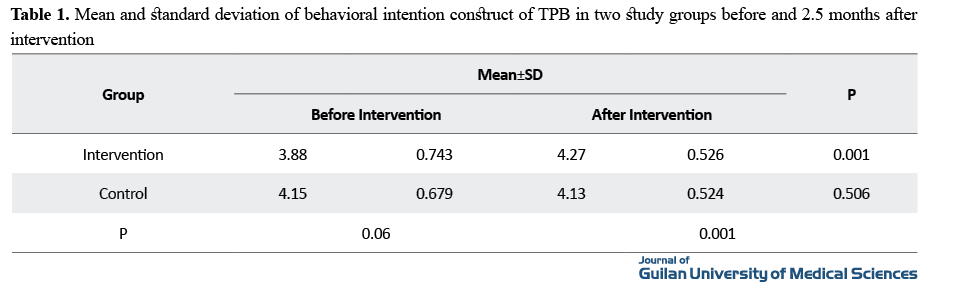
The mean age of participants (n=150) was 56.08 years and the majority of them were married, female, and housekeeper. One-third of them regularly referred to control their weight and the most of them were taking blood pressure medications. Most of them had no history of receiving relaxation therapy to reduce their stress. The statistical test results showed a significant statistical difference between the control and intervention groups after intervention in all constructs of TPB (p<0.05) (Table 1).
4. Discussion and Conclusion
The goal of this study was to improve self-care behaviors in hypertensive patients. For this purpose, behavioral goals such as physical activity, DASH diet, and correct consumption of hypertension drugs were used. The results showed that the use of TPB-based intervention can help hypertensive patients to adopt and to have self-care behaviors. For generalizing the results to other groups, the cultural and social factors should be considered.
Ethical Considerations
Compliance with ethical guidelines
This study was approved by the Ethics Committee of the Guilan University of Medical Sciences (Code: 4930231618) and was registered by Iranian Registry of Clinical Trials (Code: IRCT2016011622984N1). All ethical principles were observed in this study. The participants were informed about the research objectives and methods and were assured of the confidentiality of their information, and were free to leave the study at any time.
Funding
The study was supported by Vice-Chancellor for Research, Guilan University of Medical Sciences.
Authors' contributions
All authors equally contributed to preparing this article.
Conflicts of interest
The authors declared no conflict of interest.
Acknowledgements
The authors would like to thank the Vice-Chancellor for Research of Guilan University of Medical Sciences, faculty members, personnel of health centers, and all patients who participated in the study for their support and cooperation.
Cardiovascular diseases account for to a significant rate of mortalities in the world and are the most important causes of mortality in the United States [1]. Hypertension is one of the most important risk factors for cardiovascular patients [2, 3] whose prevalence increases by increase of age [4]. It is one of the general health problems worldwide. Hypertension is defined as a systolic blood pressure of 140 mmHg and higher and diastolic blood pressure of 90 mmHg and higher [5]. The global prevalence rate of hypertension was 26.4% in 2000 and it is estimated that about 1.54 trillion adults will suffer from this disease by 2025 [6]. The control and treatment of hypertension is one of the essential issues for both physicians and patients [7]. Regular control of hypertension can prevent or postpones its common complications [8], and can decrease deaths and disabilities caused by heart diseases [9, 10]. Early diagnosis and treatment of this disease can reduce 45% of heart disease-related deaths and 58% of cardiovascular disease-related deaths [11]. This study aims to assess the effects of a program based on Theory of Planned Behavior (TPB) on self-care behaviors among hypertensive patients.
2. Methods
This is a clinical trial. Data collection tools were a demographic form surveying age, gender, occupation, marital status, education level, history of smoking and high blood pressure; the Global Physical Activity Questionnaire (GPAQ) with 16 items; the Food Frequency Questionnaire (FFQ), and a TPB questionnaire with five constructs of attitude (4 items), subjective norms (5 items), perceived behavioral control (3 items), and behavioral intention (4 items) related to hypertension. Its items related to attitude are rated on a 5-point Likert scale (strongly agree, agree, no idea, disagree, strongly disagree) and the score ranged from 4 to 20. The items related to subjective norm construct rated on 5 point Likert scale (strongly agree, agree, neither agree nor disagree, disagree, strongly disagree) with a score ranged from 5 to 25. The two items related to perceived behavioral control construct rated on a 5 point Likert scale (strongly agree, agree, neither agree nor disagree, disagree, strongly disagree) with a score ranged from 2 to 10, and the third item rated as completely, high, low, very low, and never with a score ranged 1-5. The three items related to behavioral intention construct rated as completely true, somewhat true, no idea, not true, not true at all with a score ranged from 3 to 15, and the final item rated as always, often, rarely, sometimes, and never with a score ranged 1-5. The highest score of these constructs indicates the best personal performance.
3. Results
The mean age of participants (n=150) was 56.08 years and the majority of them were married, female, and housekeeper. One-third of them regularly referred to control their weight and the most of them were taking blood pressure medications. Most of them had no history of receiving relaxation therapy to reduce their stress. The statistical test results showed a significant statistical difference between the control and intervention groups after intervention in all constructs of TPB (p<0.05) (Table 1).
4. Discussion and Conclusion
The goal of this study was to improve self-care behaviors in hypertensive patients. For this purpose, behavioral goals such as physical activity, DASH diet, and correct consumption of hypertension drugs were used. The results showed that the use of TPB-based intervention can help hypertensive patients to adopt and to have self-care behaviors. For generalizing the results to other groups, the cultural and social factors should be considered.
Ethical Considerations
Compliance with ethical guidelines
This study was approved by the Ethics Committee of the Guilan University of Medical Sciences (Code: 4930231618) and was registered by Iranian Registry of Clinical Trials (Code: IRCT2016011622984N1). All ethical principles were observed in this study. The participants were informed about the research objectives and methods and were assured of the confidentiality of their information, and were free to leave the study at any time.
Funding
The study was supported by Vice-Chancellor for Research, Guilan University of Medical Sciences.
Authors' contributions
All authors equally contributed to preparing this article.
Conflicts of interest
The authors declared no conflict of interest.
Acknowledgements
The authors would like to thank the Vice-Chancellor for Research of Guilan University of Medical Sciences, faculty members, personnel of health centers, and all patients who participated in the study for their support and cooperation.
- Cannon CP. Cardiovascular disease and modifiable cardiometabolic risk factors. Clinical Cornerstone. 2007; 8(3):11-28. [DOI:10.1016/S1098-3597(07)80025-1] [PMID]
- Abdollahy AA, Bazrafshan HR, Salehi A, Behnampour N, Hosayni SA, Rahmany H, et al. [Epidemiology of hypertension among urban population in Golestan province in north of Iran (Persian)]. Journal of Gorgan University of Medical Sciences. 2007; 8(4):37-41. http://goums.ac.ir/journal/browse.php?a_id=87&sid=1&slc_lang=en
- Mirzaei Alavijeh M, Nasirzadeh M, Jalilian F, Mostafavei F, Hafezi M. Self-efficacy of health promotion behaviors in hypertensive patients. Daneshvar Medicine. 2012; 19(98):1-9. https://www.researchgate.net/publication/319207071_Self-efficacy_of_health_promotion_behaviors_in_hypertensive_patients
- Sharifi F, Mirarefin M, Fakhrzadeh H, Saadat S, Ghaderpanahi M, Badamchizade Z, et al. [Prevalence of hypertension and diabetes in elderly residents of Kahrizak (Persian)]. Salmand: Iranian Journal of Ageing. 2009; 4(1):16-29. https://salmandj.uswr.ac.ir/article-1-329-en.html
- Yadav G, Chaturvedi S, Grover VL. Prevalence, awareness, treatment and control of hypertension among the elderly in a resettlement colony of Delhi. Indian Heart Journal. 2008; 60(4):313-7. [PMID]
- Kearney PM, Whelton M, Reynolds K, Muntner P, Whelton PK, He J. Global burden of hypertension: Analysis of worldwide data. The Lancet. 2005; 365(9455):217-23. [DOI:10.1016/S0140-6736(05)17741-1] [PMID]
- Mahmoodi Rad Gh, Mahmoodi- Rad Z. [Knowledge of hypertensive patients about level of their blood pressure (Persian)]. Journal of Birjand University of Medical Sciences. 2006; 13(1):42-8. http://journal.bums.ac.ir/article-1-60-en.html
- Abasi M, Salemi S, Seyed Fatemi N, Hoseini F. [Hypertensive patients, their compliance level and its’ relation to their health beliefs (Persian)]. Iran Journal of Nursing. 2005; 18(41-42):61-8. http://ijn.iums.ac.ir/article-1-18-fa.html
- Applegate WB. Hypertension in elderly patients. Annals of Internal Medicine. 1989; 110(11):901-15. [DOI:10.7326/0003-4819-110-11-901]
- Zhao Y, Yan H, Marshall RJ, Dang S, Yang R, Li Q, et al. Trends in population blood pressure and prevalence, awareness, treatment, and control of hypertension among middle-aged and older adults in a rural area of Northwest China from 1982 to 2010. PloS One. 2013; 8(4):e61779. [DOI:10.1371/journal.pone.0061779] [PMID] [PMCID]
- Azizi A, Abasi MR, Abdoli GH. [The prevalence of hypertension and its association with age, sex and BMI in a population being educated using community-based medicine in Kermanshah: 2003 (Persian)]. Iranian Journal of Endocrinology and Metabolism. 2008; 10(4):323-9. http://ijem.sbmu.ac.ir/browse.php?a_id=578&sid=1&slc_lang=en
- Baghiyani Moghaddam MH, Ayvazi S, Mazloomi Mahmoodabad SS, Fallahzadeh H. [Factors in relation with self- regulation of Hypertension, based on the Model of Goal Directed behavior in Yazd city (2006) (Persian)]. Journal of Birjand University of Medical Sciences. 2008; 15(3):78-87. http://journal.bums.ac.ir/article-1-347-en.html
- Beato CV. A health message: When it comes to hypertension, we need your help. Journal of the National Medical Association. 2004; 96(8):1105-6. [PMID] [PMCID]
- Gillibrand R, Stevenson J. The extended health belief model applied to the experience of diabetes in young people. British Journal of Health Psychology. 2006; 11(1):155-69. [DOI:10.1348/135910705X39485] [PMID]
- Great Britain. Department of Health. Public attitudes to self care: Baseline survey. London: Department of Health; 2005. https://books.google.com/books?id=Ss2RnQEACAAJ&dq
- Khosravi AR, Ansari R, Shirani SH, Baghaei AM. [The causes of failure to control hypertension in population aged over 65 (Persian)]. Journal of Inflammatory Diseases. 2005; 9(2):8-14. https://journal.qums.ac.ir/article-1-278-en.html
- Barati M, Bayat F, Asadi ZA, Afshari Moshir F, Afshari M. [Relationship between health literacy and self-care behaviors in hypertensive patients (Persian)]. Journal of Education and Community Health. 2020; 7(2):89-96. [DOI:10.29252/jech.7.2.89]
- Ahmadi Tabatabaei SV, Taghdisi MH, Nakheei N, Balali F. [Effect of educational intervention based on the Theory of Planned Behaviour on the physical activities of Kerman Health Center's staff (2008) (Persian)]. Journal of Babol University of Medical Sciences. 2010; 12(2):62-9. https://jbums.org/article-1-3528-en.html
- Pakpour Hajiagha A, Mohammadi Zeidi I, Mohammadi Zeidi B. [The impact of health education based on Theory of Planned Behavior on the prevention of AIDS among adolescents (Persian)]. Iran Journal of Nursing. 2012; 25(78):1-13. http://ijn.iums.ac.ir/article-1-1363-en.html
- Jadgal KM, Zareban I, Rakhshani F, Shahrakipour M, Sepehrvand B, Alizadeh Sivaki H. [The effect of health education according to the Theory of Planned Behavior on Malaria preventive behavior in rural men of Chabahar (Persian)]. Journal of Research & Health. 2012; 2(2):236-45. http://jrh.gmu.ac.ir/article-1-46-en.html
- Karimy M, Niknami SH, Heidarnia AR, Hajizadeh E. [Psychometric properties of a Theory of Planned Behavior questionnaire for tobacco use in male adolescents (Persian)]. Journal of Sabzevar University of Medical Sciences. 2012; 19(2):190-7. http://jsums.medsab.ac.ir/article_286.html?lang=en
- National Cancer Institute. Theory at a glance: A guide for health promotion practice. Maryland: National Cancer Institute; 2005. https://books.google.com/books?id=cje4zQEACAAJ&dq
- Rezabeigi Davarani E, Mahmoodi M, Khanjani N, Fadakar Davarani M. [Application of planned behavior theory in predicting factors influencing nutritional behaviors related to cardiovascular diseases among health volunteers in Kerman (Persian)]. Journal of Health. 2018; 8(5):518-29. http://healthjournal.arums.ac.ir/article-1-1389-en.html
- Nohtani V, Zareban I, Ansari H. [Educational program based on the Theory of Planned Behavior and its effect on self-care behaviors in patients with pre-hypertension (Persian)]. Iranian Journal of Health Education and Health Promotion. 2021; 9(1):5-19. [DOI:10.52547/ijhehp.9.1.5]
- Hatefnia E, Niknami SH, Mahmudi M, Lamyian M. [The effects of “Theory of Planned Behavior” based education on the promotion of mammography performance in employed women (Persian)]. Journal of Birjand University of Medical Sciences. 2010; 17(1):50-8. http://journal.bums.ac.ir/article-1-560-en.html
- Zhang J, Shi L, Chen D, Wang J, Wang Y. Using the Theory of Planned Behavior to examine effectiveness of an educational intervention on infant feeding in China. Preventive Medicine. 2009; 49(6):529-34. [DOI:10.1016/j.ypmed.2009.10.002] [PMID]
- Sharifirad GR, Baghiani Moghadam MH, Fathyian F, Rezaeian M. The effect of health education using behavior intention model on of cesarean in Khomainy-shahr, Iran. Iranian Journal of Nursing and Midwifery Research. 2009; 14(3):105-10. http://ijnmr.mui.ac.ir/index.php/ijnmr/article/view/93
- Hosseini M, Khavari Z, Yaghmaei F, Alavi Majd H. [Factors related to exercise performance according to Theory of Planned Behavior in female students of Shahid Beheshti University of Medical Sciences (Persian)]. Advances in Nursing and Midwifery. 2010; 19(66):1-7. https://journals.sbmu.ac.ir/en-jnm/article/view/1475
- Aghamolaei T, Tavafian SS, Madani A. Prediction of helmet use among Iranian motorcycle drivers: An application of the health belief model and the Theory of Planned Behavior. Traffic Injury Prevention. 2011; 12(3):239-43. [DOI:10.1080/15389588.2011.557757] [PMID]
- Bashirian S, Haidarnia A, Allahverdipour H, Hajizadeh E. [Application of Theory of Planned Behavior in predicting factors of substance abuse in adolescents (Persian)]. Journal of Fasa University of Medical Sciences. 2012; 2(3):156-62. [DOI:20.1001.1.22285105.2012.2.3.6.4]
- Parrott MW, Tennant LK, Olejnik S, Poudevigne MS. Theory of Planned Behavior: Implications for an email-based physical activity intervention. Psychology of Sport and Exercise. 2008; 9(4):511-26. [DOI:10.1016/j.psychsport.2007.07.002]
- Soheili S, Pirdehghan Y, Hosseini SR. [Effect of lifestyle educational intervention on blood pressure in diabetic patients with hypertension (Persian)]. Journal of Education and Community Health. 2020; 7(1):59-64. [DOI:10.29252/jech.7.1.59]
Review Paper: Research |
Subject:
General
Received: 2021/02/24 | Accepted: 2021/09/1 | Published: 2021/03/21
Received: 2021/02/24 | Accepted: 2021/09/1 | Published: 2021/03/21
| Rights and permissions | |
 |
This work is licensed under a Creative Commons Attribution-NonCommercial 4.0 International License. |

Copyright © The Author(s);
This is an open access article distributed under the terms of the
Creative Commons Attribution License (CC-By-NC),which permits use, distribution, and reproduction in any medium,
provided the original work is properly cited and is not used forcommercial purposes.
Contact Information