

Volume 34, Issue 1 (3-2025)
JGUMS 2025, 34(1): 56-69 |
Back to browse issues page



Research code: IR.GUMS.REC.1398.533
Ethics code: IR.GUMS.REC.1398.533


Download citation:
BibTeX | RIS | EndNote | Medlars | ProCite | Reference Manager | RefWorks
Send citation to:


BibTeX | RIS | EndNote | Medlars | ProCite | Reference Manager | RefWorks
Send citation to:
Hemmati Noedoust Gilani M, Savat Pour H, Habibi R. The Effect of Perceived Transformational Leadership on Work Engagement of Nurses Mediated by Organizational Identification. JGUMS 2025; 34 (1) :56-69
URL: http://journal.gums.ac.ir/article-1-2490-en.html
URL: http://journal.gums.ac.ir/article-1-2490-en.html


1- Department of Management, Payame Noor University, Tehran, Iran.
2- Department of Management, Payame Noor University, Rasht, Iran.
2- Department of Management, Payame Noor University, Rasht, Iran.
Full-Text [PDF 4594 kb]
(396 Downloads)
| Abstract (HTML) (1285 Views)
Full-Text: (484 Views)
Introduction
Nurses are a very important part of the healthcare system. In Iran, turnover intention among nurses is higher than in developed countries; 72.3% of Iranian nurses who left their jobs have no intention to return [6]. Work engagement is very important in nurses. It can reduce turnover intention [7] and is the opposite of job burnout. Work engagement can lead to increased work effectiveness. One of the variables affecting work engagement is organizational identification [10]. Organizational identification influences hospital attractiveness and helps hospitals increase nurses’ motivation or attract better and more qualified nurses [3]. Another factor that can affect employees’ work engagement is transformational leadership [12]. Transformational leaders behave in a way that inspires followers to have a long-term goal, stimulates their thinking, and pays attention to each of them [13]. These leaders strengthen the process of creating commitment in employees and lead them towards organizational identification and work engagement [5]. Transformational leadership affects organizational identification [17]. This study aims to investigate the effect of transformational leadership style on the work engagement of nurses at Guilan University of Medical Sciences (GUMS), northern Iran, considering the mediating role of organizational identification.
Methods
This is a descriptive-correlational study. The study population consists of 4000 GUMS nursing students working in public hospitals in Guilan Province. Using a convenience sampling method, 318 eligible nurses were selected. The instruments included the 7-item global transformational leadership scale (GTLS) by Carless et al. [18], 4-item organizational identification scale (OIS) by Smitds et al. [19] and 8-item Utrecht work engagement scale (UWES) by Schaufeli et al. [20]. We used the Persian versions of these questionnaires. Cronbach’s α coefficients were calculated and obtained as 0.81, 0.90, and 0.77 for the GTLS, OIS and UWES, respectively. SPSS software, version 26 and PLS software, version 3 were used to analyze the collected data. For this purpose, partial least squares structural equation modeling (SEM) was used.
Results
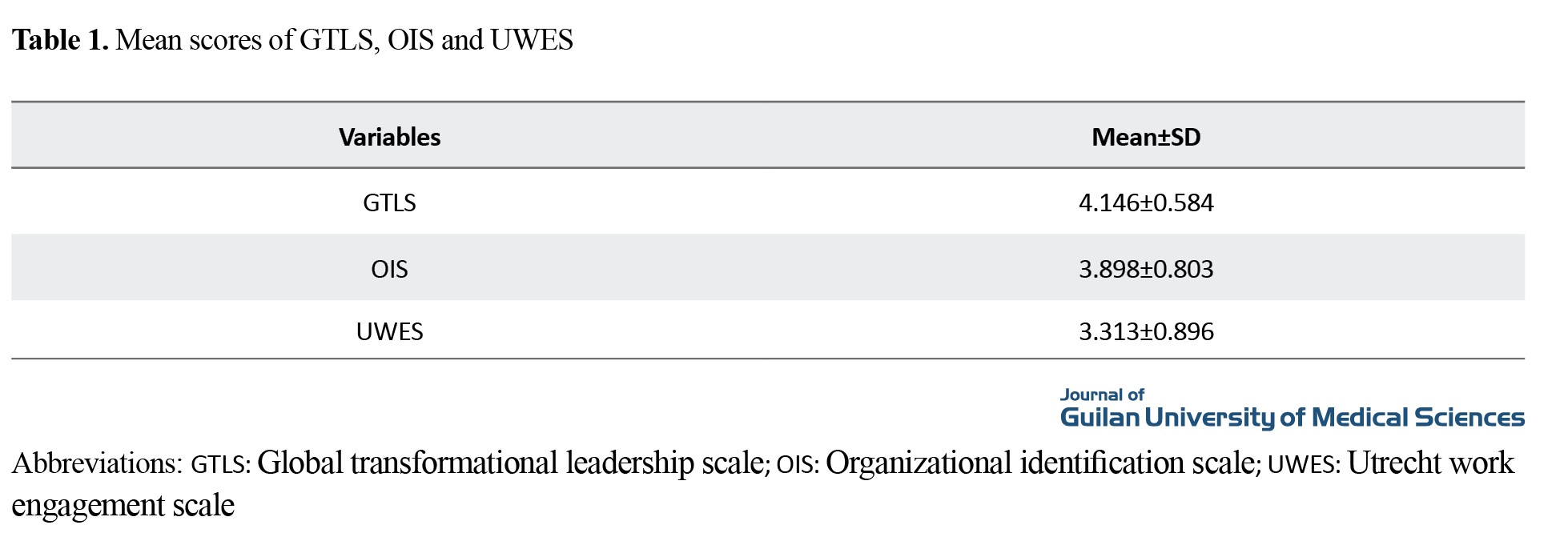
Most of the nurses were male (68.24%), aged 20-30 (50.94%), and had a bachelor’s degree (64.46%). Their mean scores of GTLS, OIS and UWES are presented in Table 1.
To assess the research hypotheses, first, the factor loading of the items was calculated. The factor loading of item 4 in the GTLS was less than 0.4 and, thus, was removed from the study model. Also, the convergent validity index (average variance extracted) of all variables (except transformational leadership) was greater than 0.5 and was approved. This index was modified to be more than 0.5 by removing item 1 from the GTLS. Divergent validity was also assessed and confirmed using the Fornell-Larcker criterion. The GoF index value (0.47) indicated a strong fit of the model. The results of testing the research hypotheses were as follows (Figures 1 and 2):
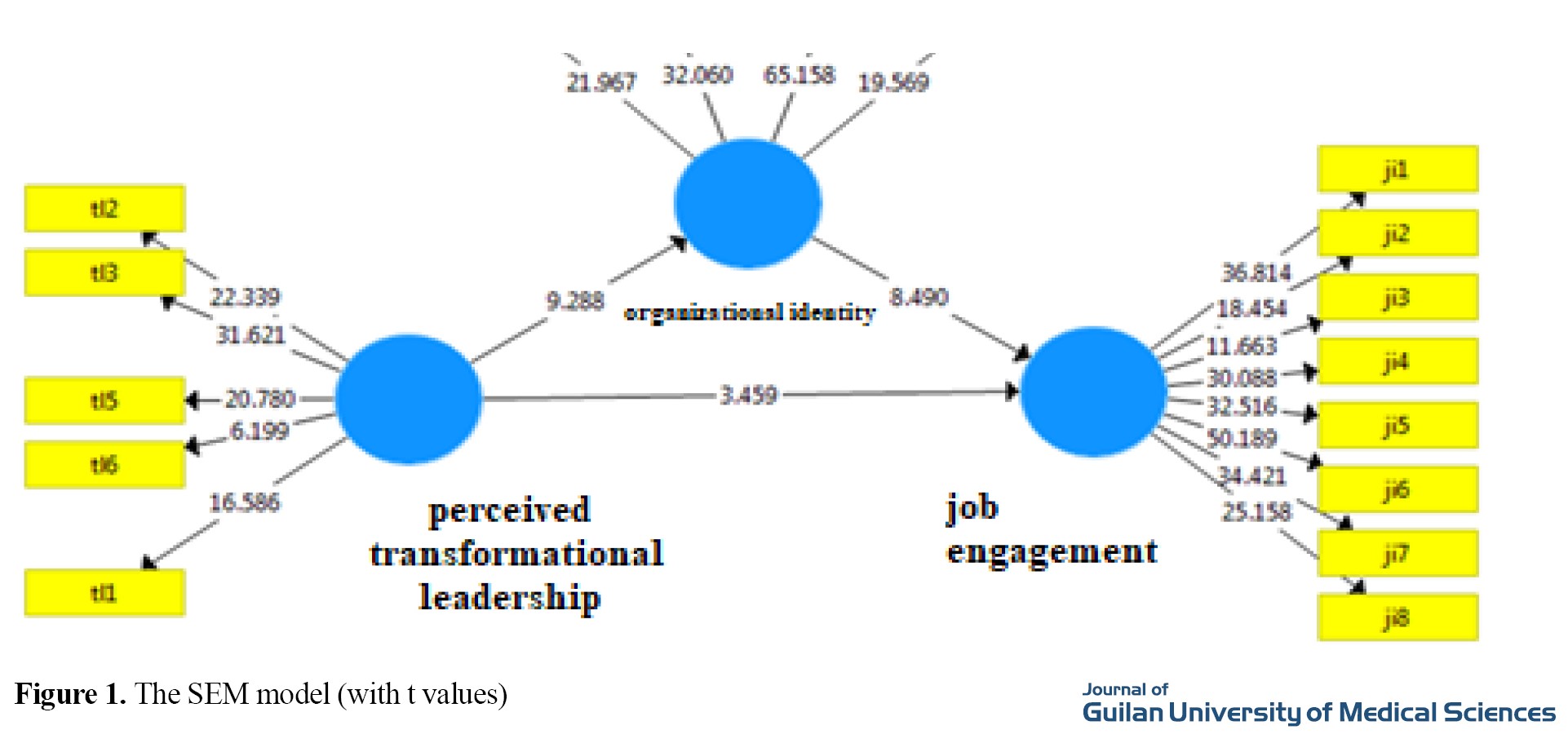
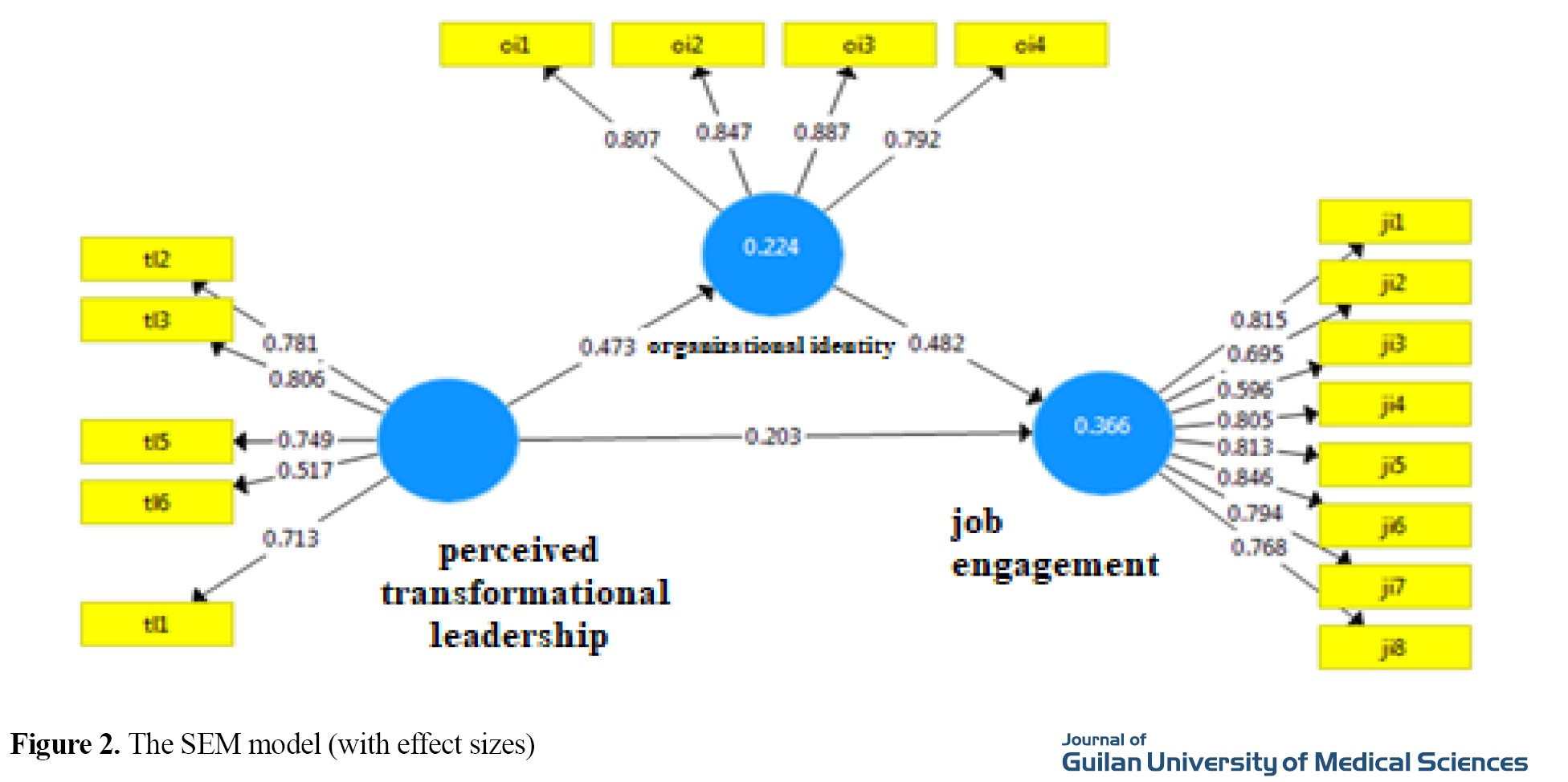 Transformational leadership had a significant effect on the organizational identification of nurses, since t=9.288, which was greater than 1.96. The effect size was 0.473.
Transformational leadership had a significant effect on the work engagement of nurses, since t=3.459, which was >1.96. The effect size was 0.203. Organizational identification had a significant effect on the work engagement of nurses, since t=8.490, which was >1.96. The effect size was 0.482.
Transformational leadership had a significant effect on the work engagement of nurses through organizational identification. Based on the results of the Sobel test and the VAF index, the level of significance was 6.230. The medication effect size was obtained as 0.529 by considering a=0.473, b=0.782, c= 0.203, Sa=0.051, and Sb= 0.057.
Conclusion
According to the results, it can be said that the improvement in the transformational leadership of managers and authorities of hospitals affiliated with the GUMS can increase nurses’ organizational identification and work engagement. Organizational identification of nurses has a mediating role in the relationship between transformational leadership and the work engagement of nurses. Therefore, it is recommended that managers of the GUMS and the affiliated hospitals should try to interact with the nurses more and listen to their suggestions and criticisms. If their criticisms and suggestions cannot be implemented or accepted, they should talk to them in a logical, documented, and transparent manner so that they understand the reasons. To increase their organizational identification, managers should be sympathetic to nurses and show that they understand and care about their problems. It is recommended that further studies be conducted on other job categories in the GUMS hospitals.
Ethical Considerations
Compliance with ethical guidelines
This study was approved by the Research Ethics Committee of Guilan University of Medical Sciences (GUMS), Rasht, Iran (Code: IR.GIMS.REC.1398.533).
Funding
This research did not receive any grant from funding agencies in the public, commercial, or non-profit sectors.
Authors' contributions
Conceptualization, methodology, validation, analysis, project management, review and editing: Mahnaz Hemmati Noadoust Gilani, and Roozbeh Habibi; Investigation, resources, visualization, writing the original draft: All authors; Supervision: Mahnaz Hemmati Noadoust Gilani.
Conflicts of interest
The authors declared no conflict of interest.
Acknowledgements
The authors would like to express their gratitude to the Vice Chancellor for Research and Technology, the officials of the Nursing Department of Guilan University of Medical Sciences (GUMS), and the nurses who helped in carrying out this research.
References
Nurses are a very important part of the healthcare system. In Iran, turnover intention among nurses is higher than in developed countries; 72.3% of Iranian nurses who left their jobs have no intention to return [6]. Work engagement is very important in nurses. It can reduce turnover intention [7] and is the opposite of job burnout. Work engagement can lead to increased work effectiveness. One of the variables affecting work engagement is organizational identification [10]. Organizational identification influences hospital attractiveness and helps hospitals increase nurses’ motivation or attract better and more qualified nurses [3]. Another factor that can affect employees’ work engagement is transformational leadership [12]. Transformational leaders behave in a way that inspires followers to have a long-term goal, stimulates their thinking, and pays attention to each of them [13]. These leaders strengthen the process of creating commitment in employees and lead them towards organizational identification and work engagement [5]. Transformational leadership affects organizational identification [17]. This study aims to investigate the effect of transformational leadership style on the work engagement of nurses at Guilan University of Medical Sciences (GUMS), northern Iran, considering the mediating role of organizational identification.
Methods
This is a descriptive-correlational study. The study population consists of 4000 GUMS nursing students working in public hospitals in Guilan Province. Using a convenience sampling method, 318 eligible nurses were selected. The instruments included the 7-item global transformational leadership scale (GTLS) by Carless et al. [18], 4-item organizational identification scale (OIS) by Smitds et al. [19] and 8-item Utrecht work engagement scale (UWES) by Schaufeli et al. [20]. We used the Persian versions of these questionnaires. Cronbach’s α coefficients were calculated and obtained as 0.81, 0.90, and 0.77 for the GTLS, OIS and UWES, respectively. SPSS software, version 26 and PLS software, version 3 were used to analyze the collected data. For this purpose, partial least squares structural equation modeling (SEM) was used.
Results
Most of the nurses were male (68.24%), aged 20-30 (50.94%), and had a bachelor’s degree (64.46%). Their mean scores of GTLS, OIS and UWES are presented in Table 1.
To assess the research hypotheses, first, the factor loading of the items was calculated. The factor loading of item 4 in the GTLS was less than 0.4 and, thus, was removed from the study model. Also, the convergent validity index (average variance extracted) of all variables (except transformational leadership) was greater than 0.5 and was approved. This index was modified to be more than 0.5 by removing item 1 from the GTLS. Divergent validity was also assessed and confirmed using the Fornell-Larcker criterion. The GoF index value (0.47) indicated a strong fit of the model. The results of testing the research hypotheses were as follows (Figures 1 and 2):
Transformational leadership had a significant effect on the work engagement of nurses, since t=3.459, which was >1.96. The effect size was 0.203. Organizational identification had a significant effect on the work engagement of nurses, since t=8.490, which was >1.96. The effect size was 0.482.
Transformational leadership had a significant effect on the work engagement of nurses through organizational identification. Based on the results of the Sobel test and the VAF index, the level of significance was 6.230. The medication effect size was obtained as 0.529 by considering a=0.473, b=0.782, c= 0.203, Sa=0.051, and Sb= 0.057.
Conclusion
According to the results, it can be said that the improvement in the transformational leadership of managers and authorities of hospitals affiliated with the GUMS can increase nurses’ organizational identification and work engagement. Organizational identification of nurses has a mediating role in the relationship between transformational leadership and the work engagement of nurses. Therefore, it is recommended that managers of the GUMS and the affiliated hospitals should try to interact with the nurses more and listen to their suggestions and criticisms. If their criticisms and suggestions cannot be implemented or accepted, they should talk to them in a logical, documented, and transparent manner so that they understand the reasons. To increase their organizational identification, managers should be sympathetic to nurses and show that they understand and care about their problems. It is recommended that further studies be conducted on other job categories in the GUMS hospitals.
Ethical Considerations
Compliance with ethical guidelines
This study was approved by the Research Ethics Committee of Guilan University of Medical Sciences (GUMS), Rasht, Iran (Code: IR.GIMS.REC.1398.533).
Funding
This research did not receive any grant from funding agencies in the public, commercial, or non-profit sectors.
Authors' contributions
Conceptualization, methodology, validation, analysis, project management, review and editing: Mahnaz Hemmati Noadoust Gilani, and Roozbeh Habibi; Investigation, resources, visualization, writing the original draft: All authors; Supervision: Mahnaz Hemmati Noadoust Gilani.
Conflicts of interest
The authors declared no conflict of interest.
Acknowledgements
The authors would like to express their gratitude to the Vice Chancellor for Research and Technology, the officials of the Nursing Department of Guilan University of Medical Sciences (GUMS), and the nurses who helped in carrying out this research.
References
- Aghajani M, Mehdad A. [The effect of transformational leadership on organizational citizenship behavior and innovative behaviors among employees of Isfahan Azad University: Mediating role of work engagement (Persian)]. Knowledge & Research in Applied Psychology. 2019; 20(1):35-46. [Link]
- Subramony M, Segers J, Chadwick C, Shyamsunder A. Leadership development practice bundles and organizational performance: The mediating role of human capital and social capital. Journal of Business Research. 2018; 83:120-9. [DOI:10.1016/j.jbusres.2017.09.044]
- Rastegar A, Hassanpour Amiri M, Akbarzadeh Safouie M. [The impact of human capital and social capital on entrepreneurial intention with moderator variable of cognitive style (case of study: University of Tehran) (Persian)]. Journal of Iranian Social Development Studies. 2018 May 22;10(2):41-57. [Link]
- Taleghani G, Pourvali B, Mohammadi M, Dianati M. [A reflection on job engagement in view of psychological capital by considering the mediated role of job burnout (Persian)]. Journal of Public Administration. 2015; 7(4):765-82. [DOI:10.22059/jipa.2015.57355]
- Iqbal K, Fatima T, Naveed M. The impact of transformational leadership on nurses’ organizational commitment: A multiple mediation model. European Journal of Investigation in Health. Psychology and Education. 2019; 10(1):262-75. [DOI:10.3390/ejihpe10010021] [PMID] [PMCID]
- Su X, Ng SM. The differential impacts of collective psychological ownership and membership identification on work burnout and engagement. Journal of Social Service Research. 2019; 45(1):44-58. [DOI:10.1080/01488376.2018.1479340]
- Rahmati R, Pishgouei SA, Zareiyan A. [Turnover intention of nurses working in the selected military hospitals in Tehran (Persian)]. Military Caring Sciences Journal. 2018; 5(3):182-91. [DOI:10.29252/mcs.5.3.182]
- Pourhossein M, Firouzkohi Brinzabadi M, Kaab Omir N. [The effect of job stress on job commitment: The moderating role of resilience in nurses (Persian)]. Industrial and Organizational Psychology Studies. 2020 8(1): 255-71. [DOI:10.22055/jiops.2021.37051.1221]
- Shahpouri S, Namdari K, Abedi A. Mediating role of work engagement in the relationship between job resources and personal resources with turnover intention among female nurses. Applied Nursing Research. 2016; 30:216-21. [DOI:10.1016/j.apnr.2015.10.008] [PMID]
- Farahbakhsh S, Rasouli S. [The mediating role of perceived distributive justice in the effect of satisfaction of the compensation system on teachers’ hope for the future, job engagement and job adjustment (Persian)]. Journal of Management and Planning In Educational System, 2018; 11(1): 109-38. [Link]
- Mohammadi F. [Analyzing the role of market orientation on hospitals performance with emphasis on the role of organization brand identity (case study: Private hospitals in Isfahan city) (Persian)]. New Marketing Research Journal. 2018; 7(4):145-56. [DOI:10.22108/nmrj.2018.108466.1523]
- Saei E, Noami A, Neisee A. [Relationship between goal setting, organizational justice, job control, job self-efficacy and self-regulation with job engagement in employees of an industrial organization (Persian)]. Psychological Research. 2014; 17(1):67-85. [Link]
- Kashyap V, Chaudhary R. Linking employer brand image and work engagement: Modelling organizational identification and trust in organization as mediators. South Asian Journal of Human Resources Management. 2019; 6(2):177-201. [DOI:10.1177/2322093719844644]
- Karanika-Murray M, Duncan N, Pontes HM, Griffiths MD. Organizational identification, work engagement, and job satisfaction. Journal of Managerial Psychology. 2015; 30(8):1019-33. [DOI:10.1108/JMP-11-2013-0359]
- Yasin Ghadi M, Fernando M, Caputi P. Transformational leadership and work engagement: The mediating effect of meaning in work. Leadership & Organization Development Journal. 2013; 34(6):532-50. [DOI:10.1108/LODJ-10-2011-0110]
- Shabaninejad H, Alyari A, Gorji HA. Relationship between transformational leadership and job performance in Farabi Hospital, Iran. Journal of Health Administration. 19(65):22-9. [Link]
- Balwant P. Stay close! The role of leader distance in the relationship between transformational leadership, work engagement, and performance in undergraduate project teams. Journal of Education for Business. 2019; 94(6):369-80. [DOI:10.1080/08832323.2018.1541851]
- Carless SA, Wearing AJ, Mann L. A short measure of transformational leadership. Journal of Business and Psychology. 2000; 14:389-405. [Link]
- Smidts A, Pruyn AT, Van Riel CB. The impact of employee communication and perceived external prestige on organizational identification. Academy of Management Journal. 2001; 44(5):1051-62. [Link]
- Schaufeli WB, Bakker AB, Salanova M. The measurement of work engagement with a short questionnaire: A cross-national study. Educational and Psychological Measurement. 2006; 66(4):701-16. [DOI:10.1177/0013164405282]
- Buil I, Martínez E, Matute J. Transformational leadership and employee performance: The role of identification, engagement and proactive personality. International Journal of Hospitality Management. 2019; 77:64-75. [DOI:10.1016/j.ijhm.2018.06.014]
Review Paper: Research |
Subject:
General
Received: 2023/04/16 | Accepted: 2024/06/18 | Published: 2025/04/1
Received: 2023/04/16 | Accepted: 2024/06/18 | Published: 2025/04/1
| Rights and permissions | |
 |
This work is licensed under a Creative Commons Attribution-NonCommercial 4.0 International License. |

Copyright © The Author(s);
This is an open access article distributed under the terms of the
Creative Commons Attribution License (CC-By-NC),which permits use, distribution, and reproduction in any medium,
provided the original work is properly cited and is not used forcommercial purposes.
Contact Information